ISO 9001:2015 · Supplying aerospace without an AS9100 certificate
A lot of the aerospace supply chain runs through shops that were never required to certify to AS9100, AS9120 or AS9110 themselves — they just have to prove, on their own ISO 9001 system, that a handful of things their customer's purchase order asks for are actually under control. JBird is built ISO 9001 first, with the aerospace-specific controls available the moment a PO calls for them — not built as if you were the AS9100 shop down the street.
Clause by clause
Not a capability matrix with everything ticked. Built system-level first, and closed in the order an internal audit actually samples it.
Your manual, procedures and records under revision control — not a shared drive folder that three people edit three different ways.
A nonconformance record with root cause and effectiveness verification, the same way for every finding, not a checkbox that closes on its own.
A structured internal audit program built against your own process map, not a generic checklist bought off the shelf and bent to fit.
Inputs pulled from the system itself — audit results, corrective actions, customer feedback — rather than assembled by hand the week before.
Every clause assessed against what's actually in place, filtered to the standards you've ticked — ISO 9001 alone shows only ISO 9001's own clauses.
Customer satisfaction and performance data that actually feeds the management review, not a spreadsheet nobody opens again after the audit.
Where the bridge segment actually lives
Primes flow down aerospace-grade expectations to suppliers who were never required to hold the certificate themselves — risk carried through the work, counterfeit-parts awareness, evidence that a special process was actually approved. JBird doesn't force your whole system aerospace to get there: tick AS9100D, AS9120B or AS9110C only for the modules you need, and the rest of your system stays exactly ISO 9001.
Risk carried through the work itself, with treatments and actions that land in the master action tracker — not a register kept alongside the work rather than in it.
A suspect part found at receiving raises a nonconformance like any other finding, and the standing prevention side sits on the supplier register: an authorized/original-source flag and obsolescence monitoring per provider.
Standing approval records for heat treat, welding and NDT with revalidation dates, and first article inspections that print AS9102 Forms 1, 2 and 3 when a prime asks for one.
Worth saying plainly
Ticking a standard only adds its modules to your menu and its clauses to your gap analysis. It doesn't rewrite your scope statement behind your back, and nothing about it claims a certification you don't hold — it just means the record your customer's PO asked for has somewhere to live.
Scope, not a fixed list
The gap analysis is the same table whether you're ISO 9001 only or carrying all three aerospace standards — it just shows fewer rows. Add a standard later and the missing rows appear; nothing about your existing evidence moves.
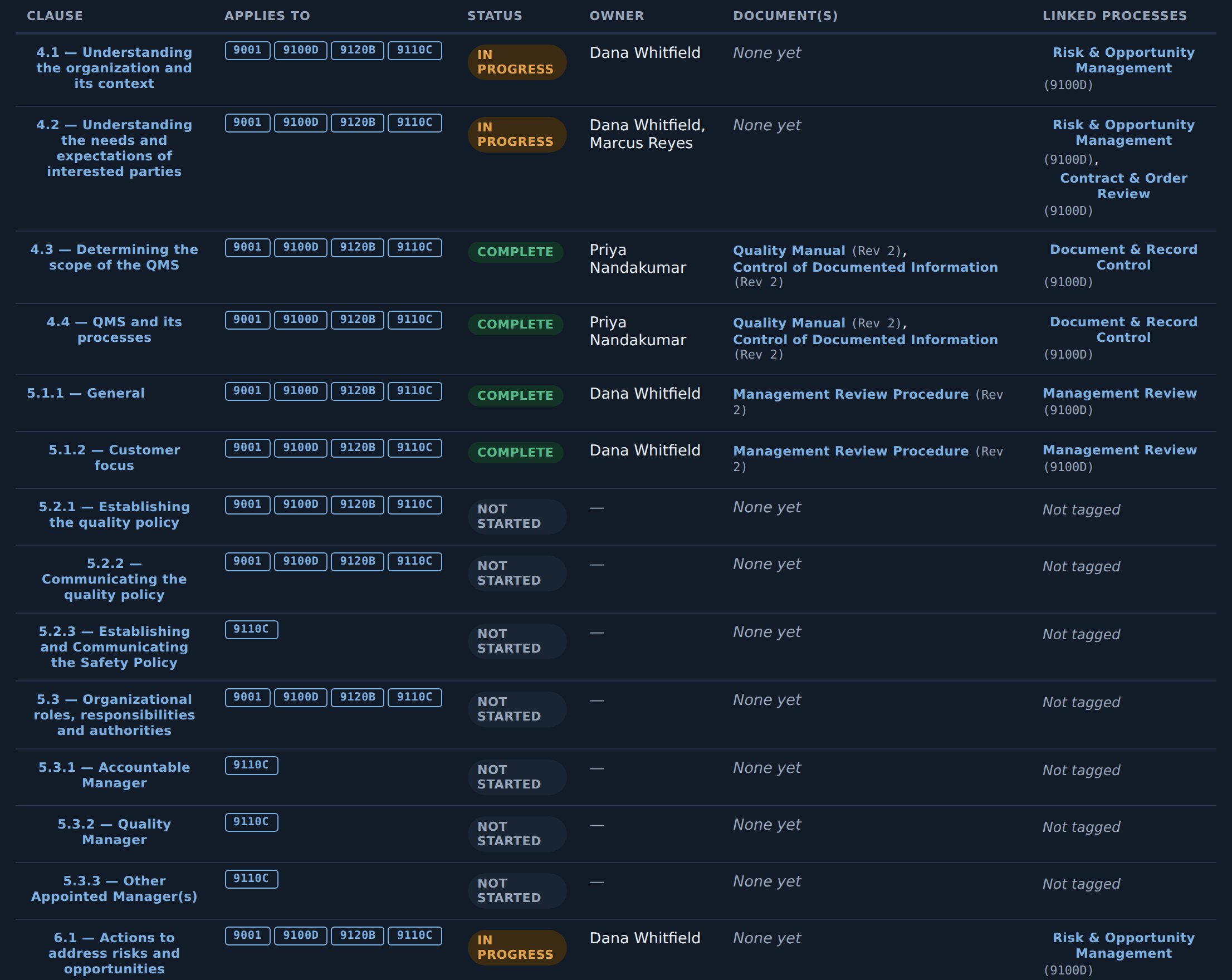
Click to enlarge.
Getting started
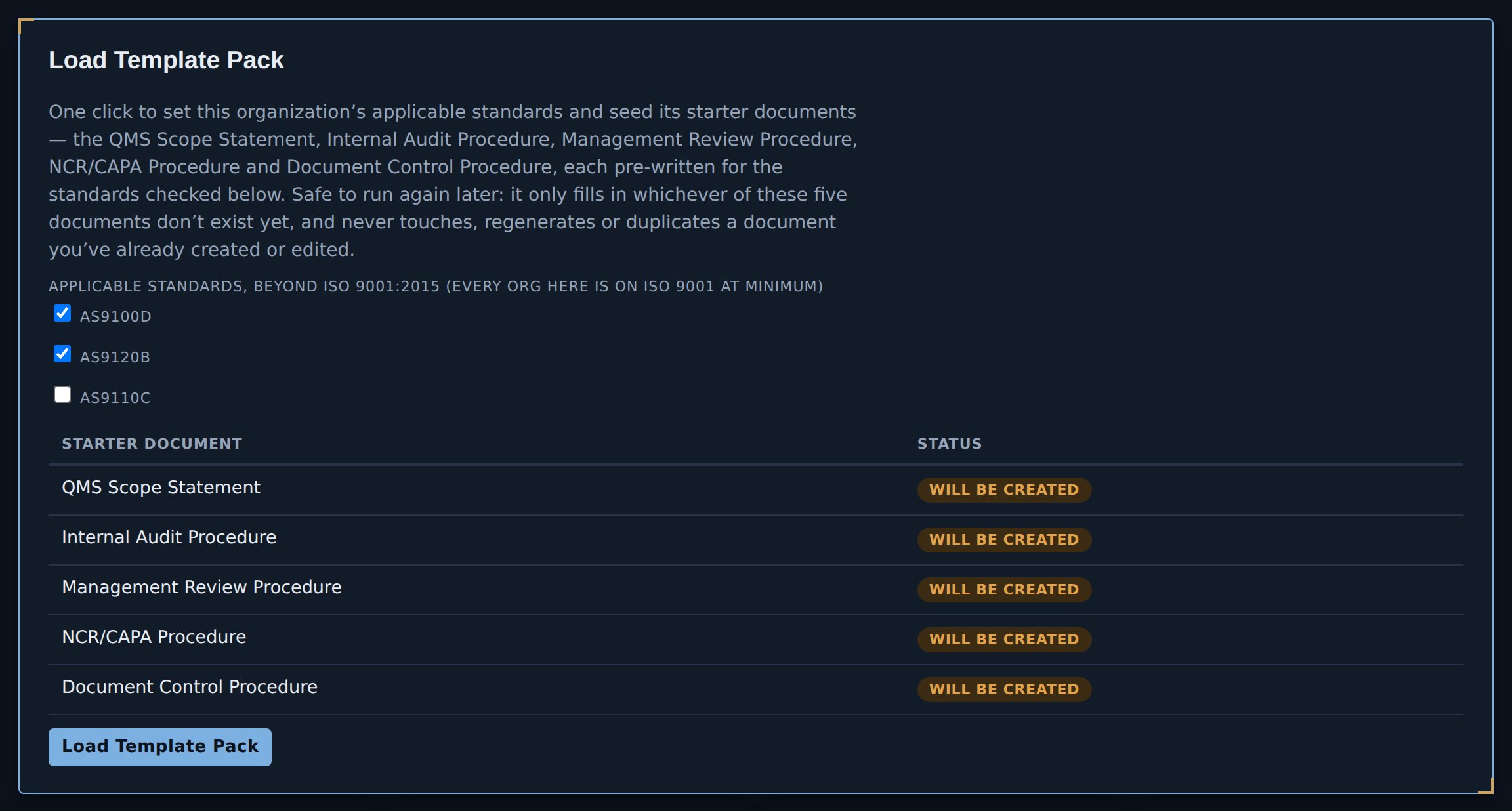
A template pack writes the five documents every quality system needs — scope statement, internal audit, management review, NCR/CAPA and document control — scoped to exactly what you've ticked. Add AS9100D, AS9120B or AS9110C later and it fills in only what's missing; it will never overwrite something you've already edited.
Click to enlarge.
Pilot program
39 modules are already built and working. Pilot organizations get the system at no cost during development, direct input on what gets built next — there is a Report a Problem button on every screen, and it goes to a register we work through — and a migration path when the IA9100 revision lands.