ISO 9001:2026 · summary written 24 September 2026
ISO published the sixth edition of ISO 9001 on 16 September 2026. We read it side by side with ISO's own redline against the 2015 edition. This is what's genuinely new, what's only wording, and what an aerospace supplier can leave alone for now.
The short version
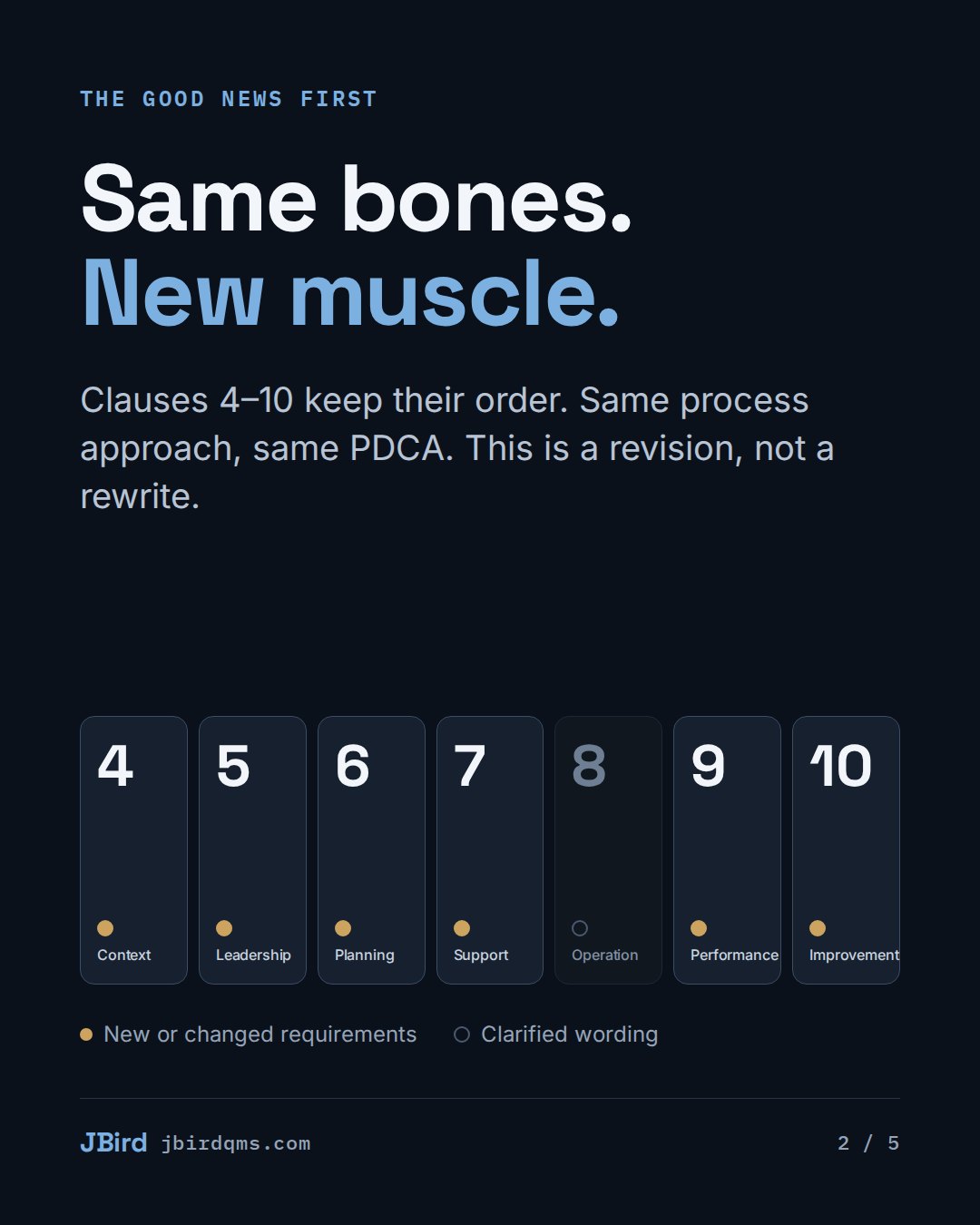
It's a revision, not a rewrite. Clauses 4 to 10 keep the same order, with the same process approach and the same plan-do-check-act cycle. Most clauses changed in wording, not substance.
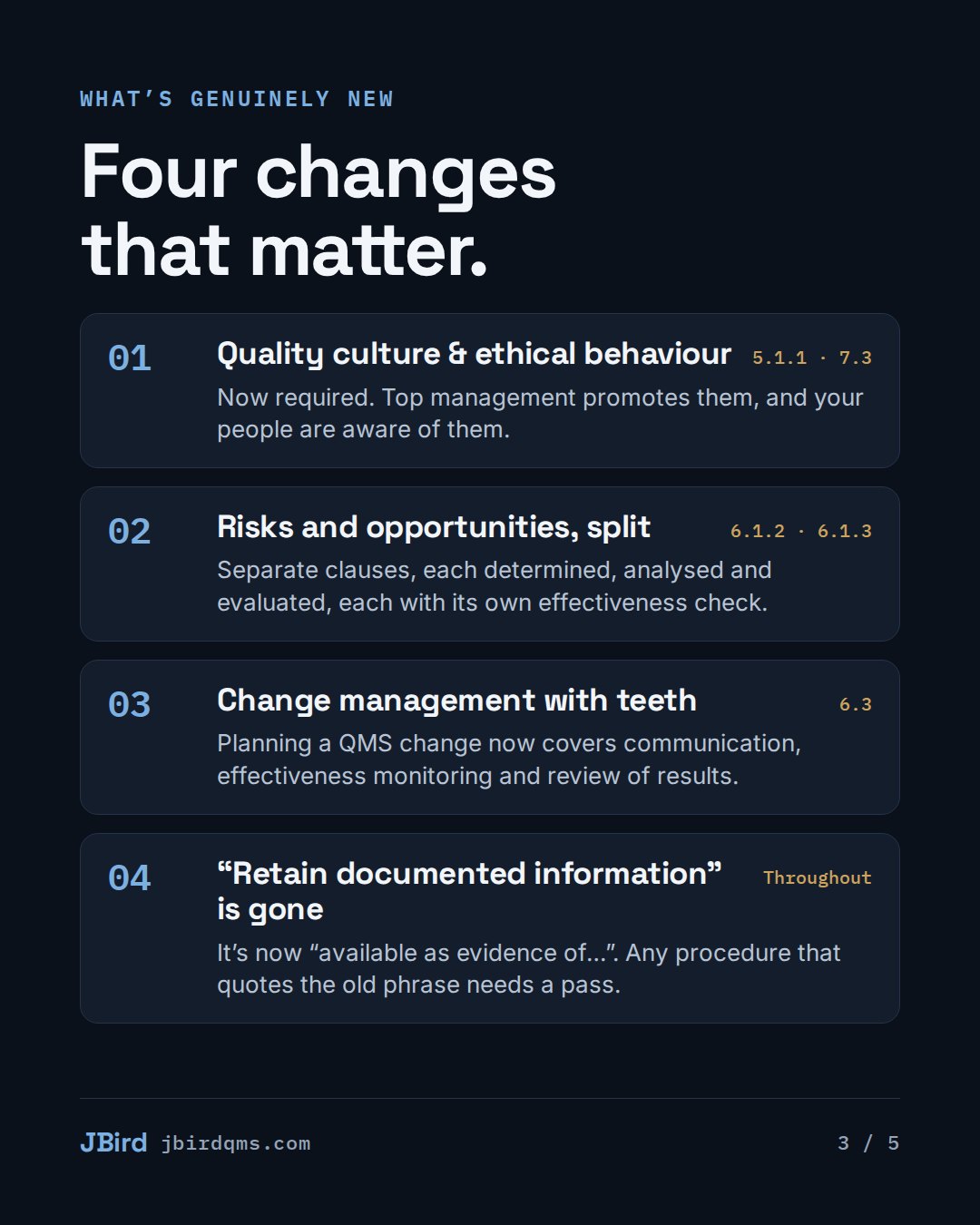
Four changes matter. Quality culture and ethical behaviour are now requirements. Risks and opportunities are handled separately. Planning of changes has more to it. And the familiar "retain documented information" wording has gone everywhere.
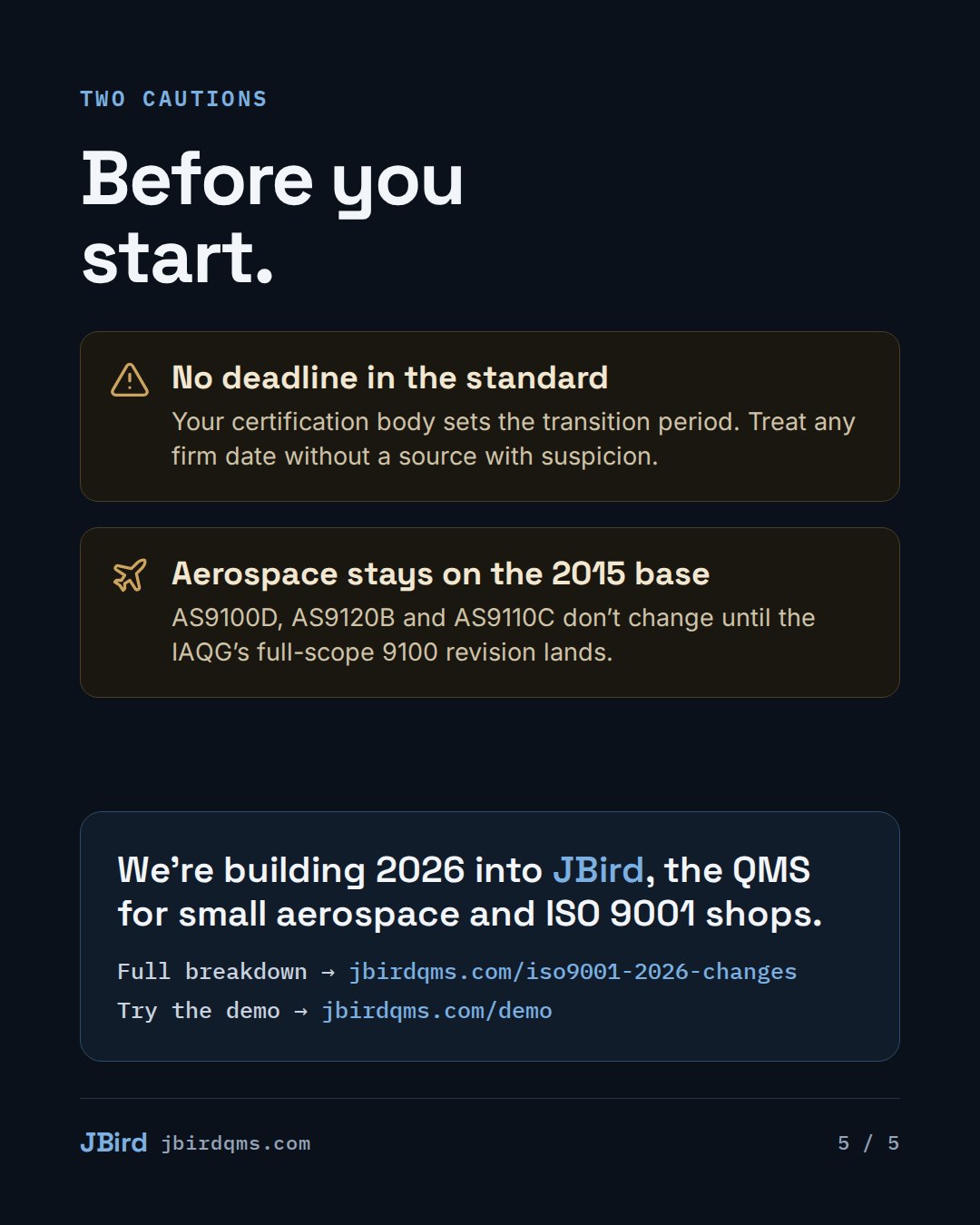
No deadline is set in the standard. Your certification body sets your transition period. AS9100D, AS9120B and AS9110C are still built on the 2015 edition and don't change until the IAQG's full 9100 revision.
At a glance
The same summary we posted on LinkedIn. Click any slide to enlarge it. The full detail follows below.
About this summary
Written by a practicing aerospace quality auditor from licensed copies of the standard and ISO's redline. Everything here is in our own words; no clause text is reproduced.
If you're implementing, buy the standard from ISO or your national standards body. This page is a map, not a substitute.
The good news first
The 2026 edition replaces ISO 9001:2015 and its climate-change amendment from 2024. Both are now withdrawn. The clause structure is untouched: context, leadership, planning, support, operation, performance evaluation and improvement, in that order. If your quality manual is organised by clause, its skeleton survives.
The core management-system terms (organization, interested party, top management and the rest) now sit inside the standard's own Clause 3, as they do in ISO's other management-system standards. ISO 9000 is still the vocabulary reference.
The climate-change requirements in 4.1 and 4.2 are shown as new in ISO's redline, but only because the redline compares against the original 2015 text. If you already implemented the 2024 amendment, there's nothing new for you there.
What's genuinely new
Top management has to promote a quality culture and ethical behaviour (5.1.1), and people have to be aware of them (7.3). This is the most visible new obligation, and the one auditors will probe first. Expect the question "what does promoting it look like here?", and have an answer that points at something real: a briefing, a metric, a decision that went the ethical way.
The old 6.1 becomes three parts: determining risks and opportunities (6.1.1), then separate clauses for acting on risks (6.1.2) and acting on opportunities (6.1.3). Each has its own planning and its own check on whether the actions worked. Two tightenings sit inside that:
A new note points at risks during and after a disruption. The split carries through to analysis and evaluation (9.1.3) and to management review (9.3.2), where risk actions and opportunity actions are now assessed separately.
When you plan a change to the quality system, the planning now has a stated purpose: make sure the change achieves its intended results. It also has to cover how the change is communicated, how its effectiveness will be monitored and how its results will be reviewed. Availability of information joins availability of resources.
Every instance is replaced by two phrasings. Something either has to be available as documented information, or documented information has to be "available as evidence of" something. Annex A confirms the second means keeping objective evidence. In practice this is a wording change, not a new obligation. But every procedure, form and audit checklist that quotes the old phrase needs a pass, or it will read as out of date at your next audit.
Easy to miss
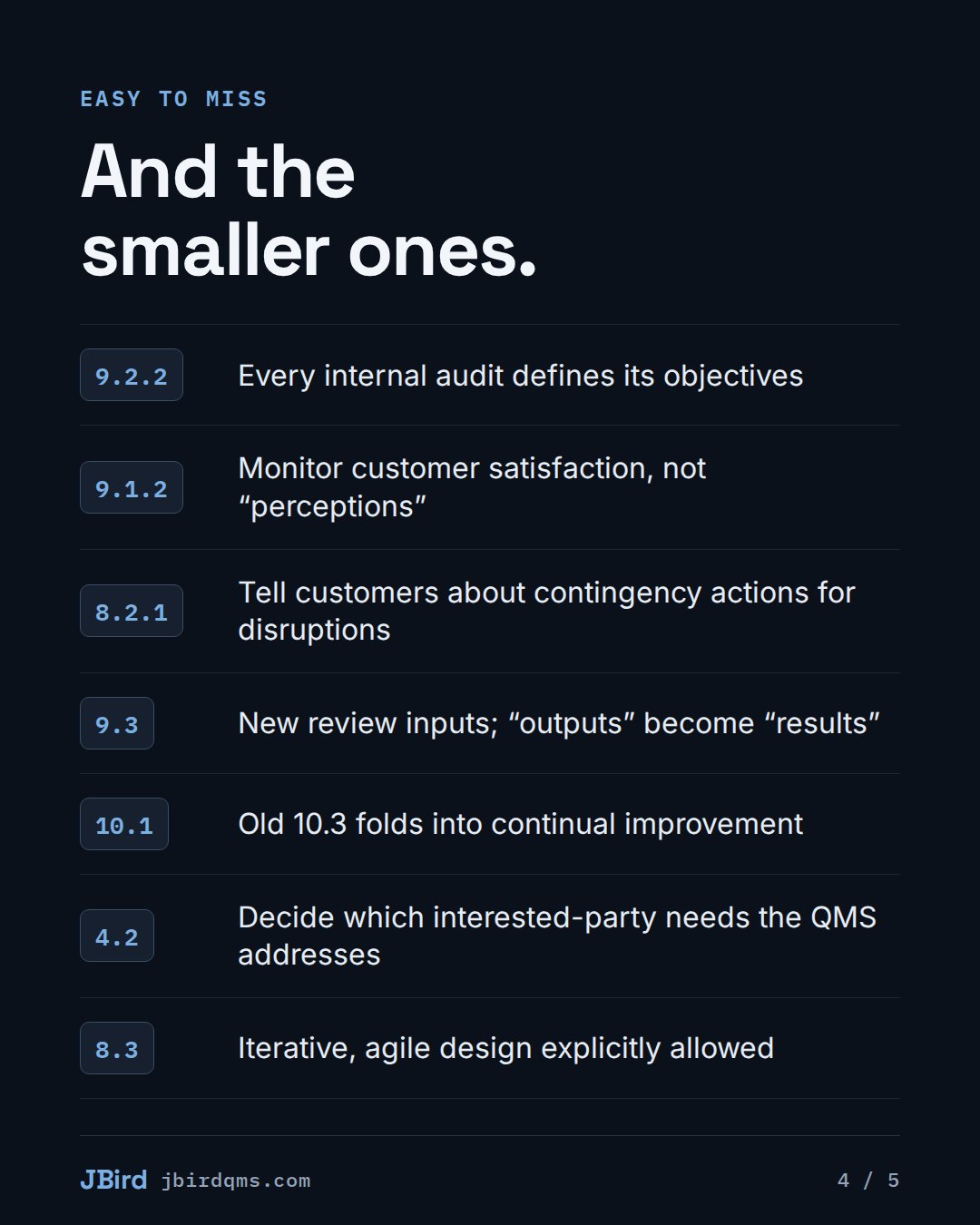
None of these will reshape a quality system on its own, but together they're what an attentive auditor will look for.
| Clause | What changed |
|---|---|
| 4.2 | Decide which of your interested parties' requirements the QMS will address. Changes in their needs become a management review input. |
| 5.1.1 | The leadership list grows from ten items to twelve, adding culture and ethics, the process approach, and risk- and opportunity-based thinking. |
| 5.3 | Reporting on QMS performance and reporting on improvement opportunities are separate assignments. |
| 6.2.1 | Quality objectives are explicitly required as documented information. |
| 7.1.3 | A note makes clear infrastructure covers on-site, remote and hybrid work. |
| 7.1.6 | Organizational knowledge has to be applied and shared, not just kept. Digital systems are named as a form of knowledge. |
| 8.1 | Restructured. Externally provided processes, products and services relevant to the QMS have to be controlled. |
| 8.2.1 | Tell customers about contingency actions, including for disruptions. Websites and social media are named as channels. |
| 8.3 | Notes explicitly allow iterative and agile design, with inputs that evolve as the work does. |
| 8.4.3 | Verification at the supplier can happen at their premises or another location, which opens the door to remote verification. |
| 9.1.2 | Monitor customer satisfaction itself, not "perceptions". Complaints and social media are listed as sources. |
| 9.2.2 | Every internal audit defines its objectives, alongside its criteria and scope. |
| 9.3 | Inputs reordered. Improvement opportunities move from outputs to inputs, and "outputs" are renamed "results". |
| 10.1 | The old 10.3, continual improvement, is merged into 10.1. Improving processes is named explicitly. |
Annex A is rewritten and Annex B is gone. Annex A now explains intent and adds no requirements. It's worth reading for its short glossary of the words that start audit arguments: appropriate versus applicable, consider versus take into account, continual versus continuous.
One more note: ISO's own announcements talk about digitalization and resilience. The requirements themselves talk about disruption, remote work and digital systems. The word "resilience" doesn't appear in the requirement text.
Before you start
ISO 9001:2026 doesn't set a transition period. ISO points certified organizations to their certification body, and that's who administers the timeline you'll actually be audited against. If someone quotes you a firm date, ask where it came from.
AS9100D, AS9120B and AS9110C are built on ISO 9001:2015, and they don't change because ISO 9001 did. The 2026 content reaches aerospace through the IAQG's full-scope 9100 revision, expected around mid-2027. Until then, your AS9100D audit is an AS9100D audit. Our 2026 aerospace standards guide covers what's coming and why the transition window is still disputed.
What to do now
Sources and honesty
This summary is drawn from licensed copies of ISO 9001:2026 and ISO's redline against the 2015 edition, read clause by clause. It is written in our own words and reproduces no text from the standard. Clause numbers are given so you can find each change in your own copy.
It's written by an aerospace quality auditor. It isn't affiliated with, endorsed by, or accredited by ISO, the IAQG or SAE, and it isn't a substitute for the published standard.
If this was useful
JBird is a quality management system for small aerospace and ISO 9001 organizations: the process map, the manual, internal audits, calibration, management review and corrective actions in one place, built by the person who wrote this page. It's in development, and we're working with a small number of pilot organizations.