Clause 4.4 · Process approach
Fewer than you have. Most quality systems are drawn with too many processes, and the reason is almost always the same: somebody started from a template instead of from the organization, and every heading in the standard became a box on the diagram.
There is no required number, and anyone who gives you one is selling something. But there is a test that settles most arguments in about a minute.
The rule of thumb
If nobody is primarily employed to execute an activity, it probably isn't a separate process — it's an activity inside a broader one.
It is not in any standard. It is a working heuristic from auditing quality systems for a living, and it is the same advice given to an auditee standing in front of a diagram they cannot explain.
Apply it and most bloated maps collapse quickly. Is there a Management Review Manager? No — the president runs the review, sets the objectives, owns the policy and chairs the risk discussion. That is one process with several activities inside it, not five processes. Is there a Document Control Officer, a Training Coordinator, a Calibration Technician and an Internal Audit Manager? In a shop of thirty people they are usually one quality manager wearing four hats, and that is one Support process.
The test cuts the other way just as often, which is what makes it a test rather than a preference. If you do employ a purchasing manager, purchasing is a process. If you employ engineers who design product, design is a process. The rule does not push you toward small maps; it pushes you toward honest ones.
The same rule, three answers
The clearest way to show a rule of thumb is working is to watch it land differently on the same question in three companies of a similar size.
Machines parts to the customer's drawing. Nobody is employed to buy — the people planning the work order the material as part of planning it. Purchasing is an activity inside Operations. Six processes total, and clause 8.3 is excluded from scope entirely because the shop takes no design responsibility.
Buys, stores and resells without altering the product. There is a purchasing manager, because buying well is the company. Purchasing & Supplier Control gets its own box, its own owner and its own metrics — and the map has a receiving and traceability process a machine shop does not need.
Designs and manufactures. It employs an engineering manager and design engineers, so Design & Development is a process of its own with its own KPIs and its own audit interval — and clause 8.3, which the other two legitimately scope out or exclude, is fully in play.
All three are fictional organizations you can open and click through in the live demo.
What usually goes wrong
A process turns inputs into outputs and somebody owns it. A procedure is a document describing how part of it is done. One process is often served by several procedures. Draw a box per procedure and the map becomes a table of contents.
The standard is organised for reading, not for running a company. Its clause structure is a useful checklist for coverage and a poor blueprint for a process map. No shop is organised around clause 7.1.5.
A twelve-box diagram looks more rigorous than a six-box one right up until an auditor asks the owner of box nine how their process is performing, and the quality manager answers — because they own boxes seven, nine and eleven and cannot possibly speak to all of them in detail.
Maps grow. A process added for a customer that left, a box for a machine no longer owned. Clause 4.4 asks you to determine the processes needed and their sequence and interaction, which is a live obligation, not a founding document.
The cost of getting it wrong
Every extra process is not just a box. It is a set of inputs and outputs to maintain, an owner to name, KPIs to measure and analyse, an audit interval to meet, and a PEAR to complete at every certification audit that samples it. Twelve processes means twelve of each. That is why over-splitting does not merely look untidy — it quietly multiplies the ongoing work of running the system, usually for an organization that did not have spare capacity in the first place.
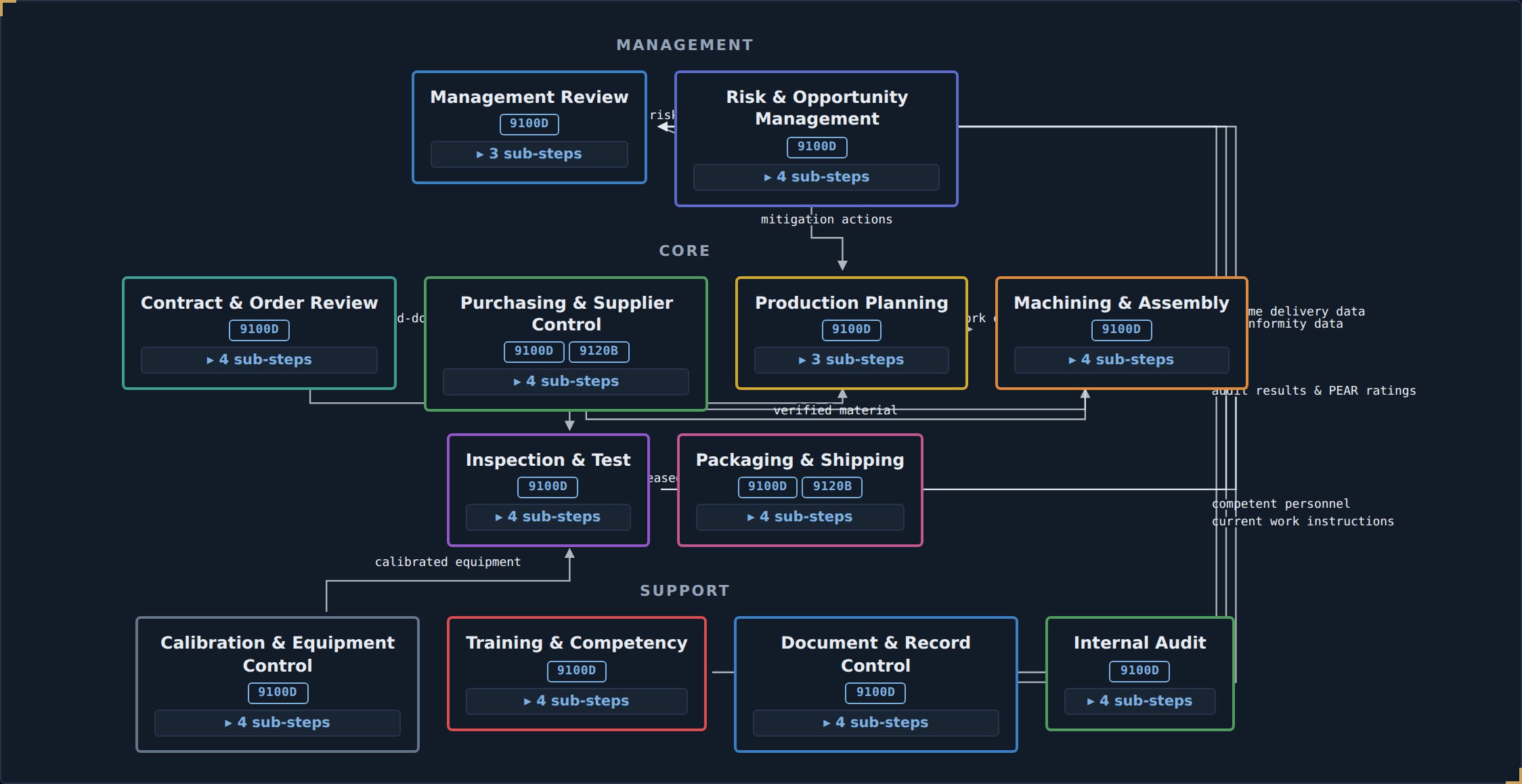
Where the detail should live
A lot of over-splitting comes from trying to make the interaction diagram carry information it was never meant to carry.
The interaction map has one job: show which process feeds which. The moment you start hanging equipment, competence, documents and metrics off the arrows, it stops being readable — and none of that belongs there anyway. It belongs in a turtle diagram or a SIPOC, one process at a time, where there is room for it. Keep the map coarse and the detail one level down, and the pressure to split disappears.
Six processes, one linear core flow, support drawn as a real process but deliberately not wired to each core box. Click to enlarge.
Common questions
There is no required number, and any consultant who gives you one is selling a template. A small manufacturer usually lands somewhere between five and eight: one management process, three to five core processes following the flow of the work, and one support process. What matters is not the count but whether each box corresponds to something a real person is primarily employed to run.
Usually not. Management review, context of the organization, risk and opportunity management, quality objectives and the quality policy are normally activities inside a single Management process. Splitting them into five boxes produces a diagram nobody reads and five sets of inputs, outputs, owners and KPIs to maintain, all owned by the same person.
No. A small machine shop with no purchasing manager usually folds purchasing into Operations, because the people planning the work are the people buying the material. A stockist distributor whose entire business is buying and reselling gives Purchasing its own process, its own owner and its own metrics. Same rule, opposite answers, both correct for the organization in question.
A process is a set of activities that turns inputs into outputs and that somebody owns. A procedure is a document describing how part of it is done. One process can be served by several procedures. Counting procedures and drawing a box for each is one of the commonest ways a process map ends up with twelve boxes.
Not on the count itself. What an auditor tests is whether the processes you have identified cover the whole quality system, whether their sequence and interaction are determined, and whether each one has an owner who can speak to how it performs. A smaller map where every owner can answer for their process is stronger than a larger one where three boxes trace back to the same overloaded quality manager.
Pilot program
Twenty-eight modules are already built and working. Pilot organizations get the system at no cost during development, direct input on what gets built next, and a migration path when the IA9100 revision lands.