AS9100D · Design and manufacture

The difference between an aerospace QMS and a relabelled one is about nine clauses.

AS9100D is ISO 9001:2015 plus a specific set of aerospace additions. Any quality tool can hold your procedures and your corrective actions. The question worth asking a vendor is what happens at 8.1.1, 8.1.2, 8.1.3 and 8.5.1 — because a generic tool with "aerospace" in the product name has no reason to have built them.

Clause by clause

What AS9100D adds, and where JBird actually stands.

Not a capability matrix with everything ticked. One of these is half done, and its card says so.

8.1.1 · built

Operational Risk Management

Risk carried through the work itself rather than a register kept alongside it, with treatments and actions that land in the master action tracker.

8.1.2 · built

Configuration Management

As-built configuration recorded against what shipped, so "which revision did we send in March" has an answer that isn't someone's memory.

8.1.3 · built

Product Safety

Safety-critical items with their criticality rationale, and a safety event log that feeds the safety-performance input management review asks for.

8.5.1.2 – 8.5.1.4 · built

Special Processes & FAI

Standing approval records for heat treat, welding and NDT with revalidation dates; first article inspections with characteristic-level results that print as AS9102 Forms 1, 2 and 3.

8.2.3 · 8.2.4 · built

Contract & Order Review

A review record per order against the standard's own requirements, and a change log with an acknowledgment step when the customer moves the spec.

8.5.2 · 8.6 · built

Acceptance authority media and release

Who stamped it, against what evidence, with the certification package that travels on to your customer.

8.1.4 · built

Counterfeit part prevention

Both halves. A suspect part found at receiving raises a nonconformance with root cause and effectiveness verification like any other finding — and the standing prevention programme sits on the supplier register: an authorized/original-source flag and obsolescence monitoring per provider, plus a counterfeit-awareness training role you can hold people against.

8.3 · built

Design and development

Design projects with the standard's own 8.3.2 planning checklist, inputs, reviews and verification, outputs with critical items flagged, and a change log.

9.2 · AS9101 · built

Audits the aerospace way

The real IAQG 9101 Form 2 process matrix and Form 3 PEAR, with the standard's own effectiveness grid — not a generic internal-audit checklist.

The record an auditor asks for first

First article inspection, including the ones that failed.

FAI is among the most consistently sampled records in a real AS9100 audit, and "how do you handle first articles" is close to the first question a prospect asks. Each record carries the part, drawing and configuration, what triggered it, whether it is a full or a partial FAI, the result and the disposition.

Underneath each one, the characteristics themselves: reference and drawing zone, requirement, nominal, tolerance, actual result, inspection method and the gauge used — and, where a characteristic failed, the nonconformance raised against it. Materials and special-process sources sit alongside them, each one pointing at the approved supplier or the standing special-process approval it came from. From those records the app prints AS9102 Forms 1, 2 and 3.
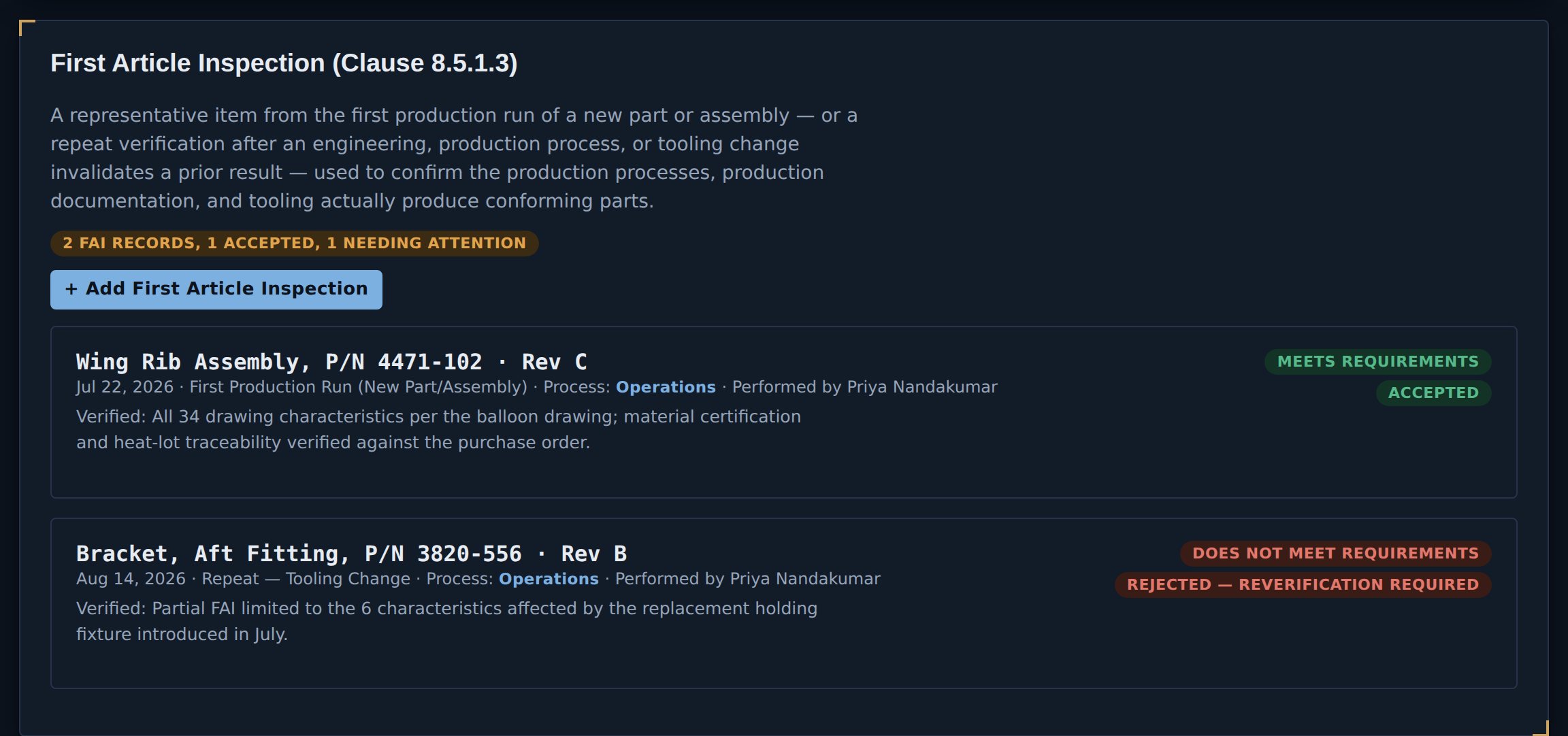
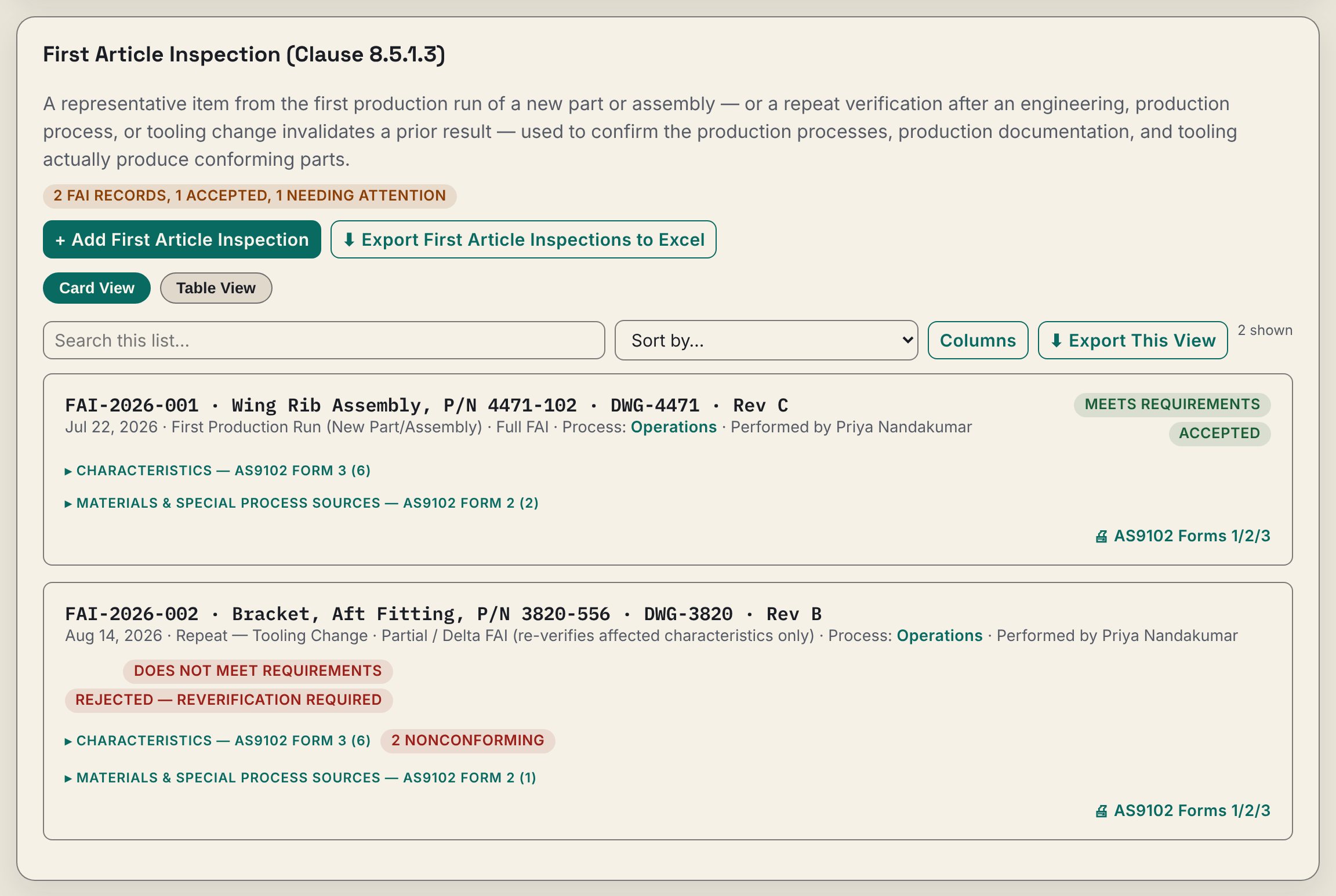
JBird's First Article Inspection panel showing two records, each with a
                    FAI report number: FAI-2026-001, a wing rib assembly at Rev C, a full FAI
                    marked meets requirements and accepted; and FAI-2026-002, an aft fitting
                    bracket repeated after a tooling change as a partial FAI, marked does not
                    meet requirements and rejected with reverification required. Each record
                    lists its AS9102 Form 3 characteristics and Form 2 sources, and offers a
                    print action for AS9102 Forms 1, 2 and 3.JBird's First Article Inspection panel showing two records, each with a
                    FAI report number: FAI-2026-001, a wing rib assembly at Rev C, a full FAI
                    marked meets requirements and accepted; and FAI-2026-002, an aft fitting
                    bracket repeated after a tooling change as a partial FAI, marked does not
                    meet requirements and rejected with reverification required. Each record
                    lists its AS9102 Form 3 characteristics and Form 2 sources, and offers a
                    print action for AS9102 Forms 1, 2 and 3.

The register. A rejected first article isn't hidden — it's the one an auditor will ask to see. Click to enlarge.

Video · 0:52A narrated walkthrough of this screen: The first article inspection register.
Read the narration

This is JBird's first article inspection register, clause 8.5.1.3. Two records, one accepted, one needing attention. The first record is a wing rib assembly, a full FAI, marked meets requirements and accepted. The second is an aft fitting bracket, repeated after a tooling change as a partial FAI. It does not meet requirements, and is rejected, with reverification required. A rejected first article is not hidden. It is the one an auditor will ask to see. Each record lists its characteristics and its material and special process sources, and prints AS9102 forms 1, 2 and 3. A rejected first article is on the record. JBird QMS.
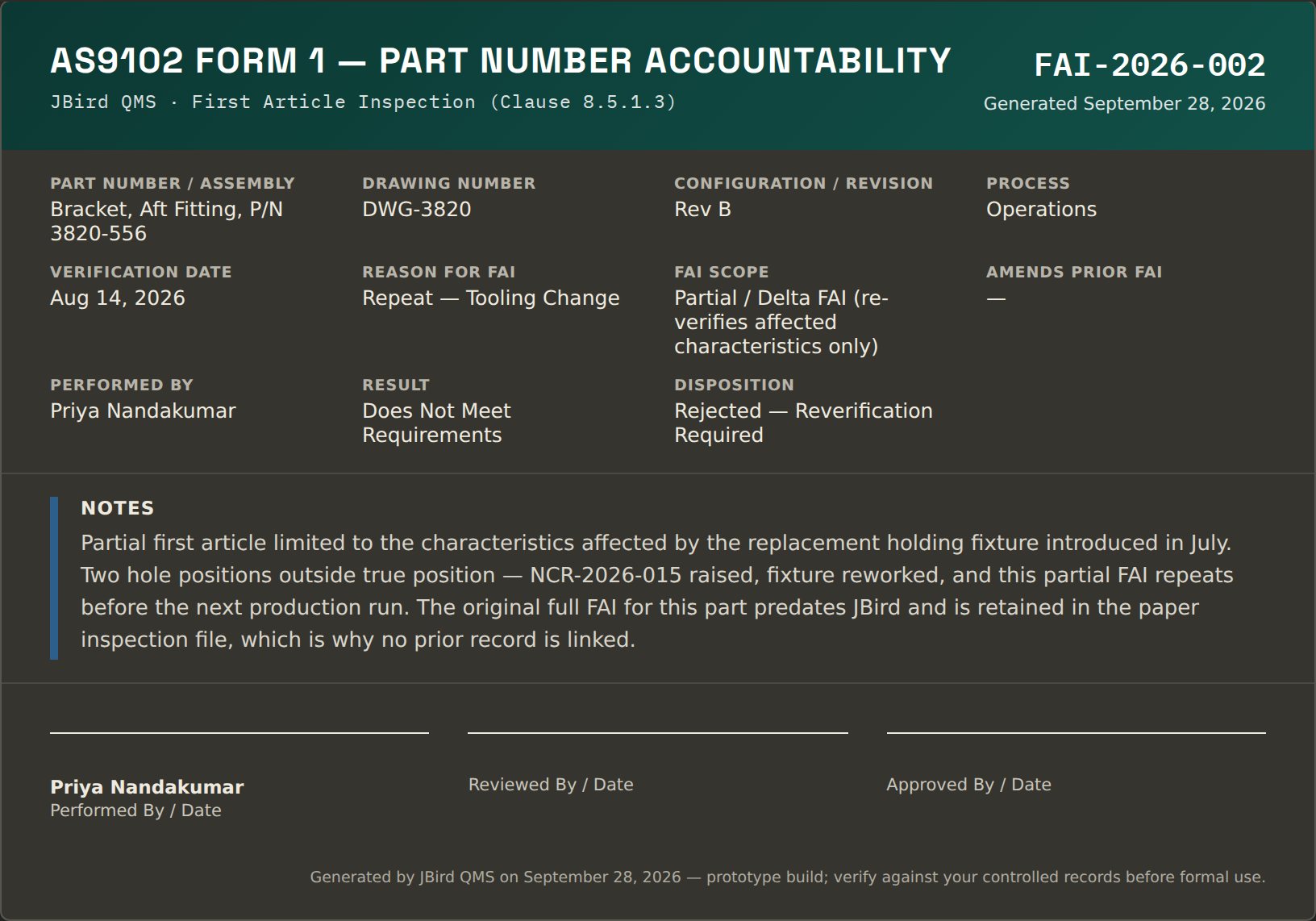
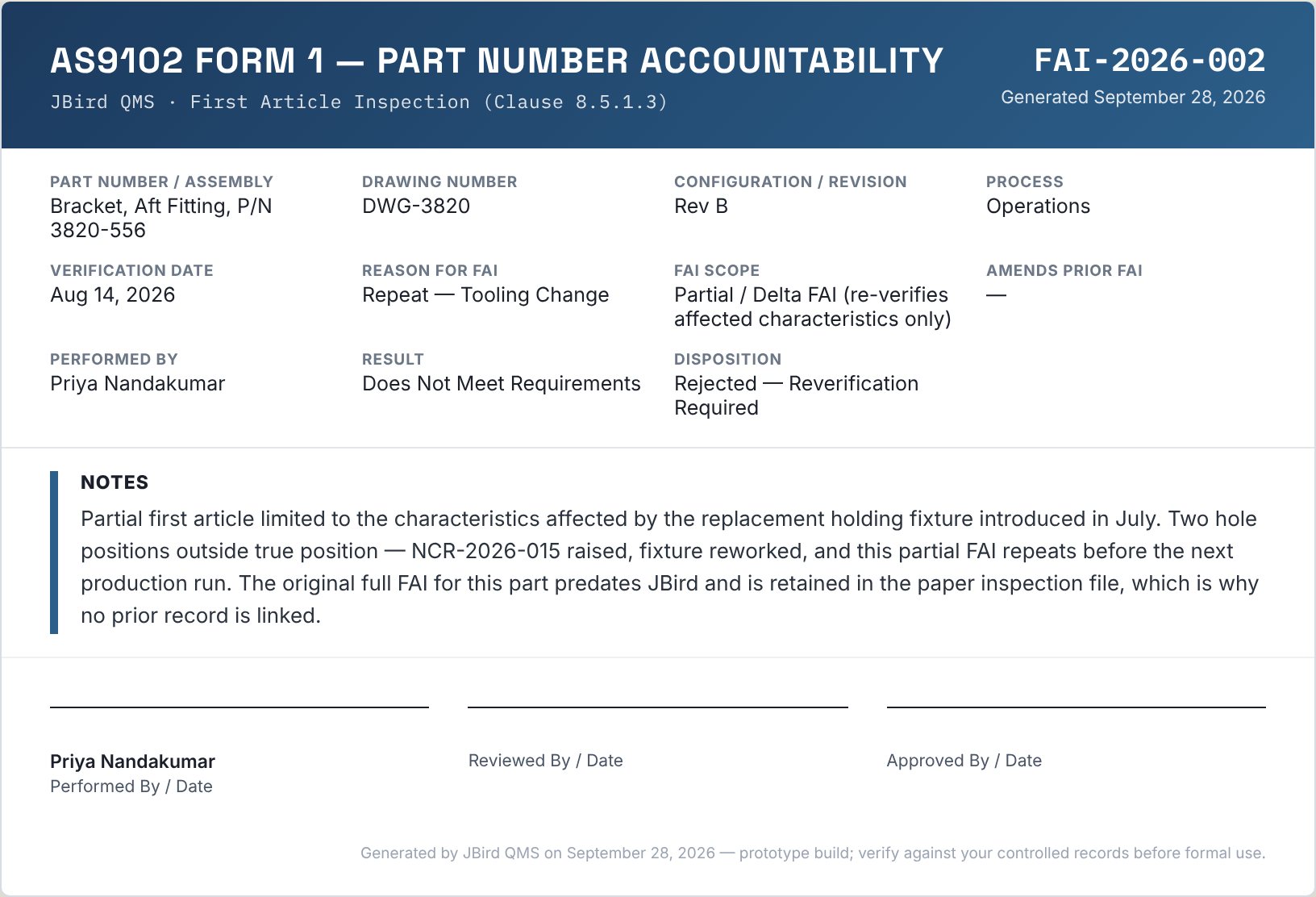
AS9102 Form 1, Part Number Accountability, printed from the rejected
                    record. It carries the FAI report number FAI-2026-002, the part and
                    drawing number, configuration Rev B, the reason for the FAI, the FAI
                    scope marked partial or delta, whether it amends a prior FAI, the result
                    and disposition, the inspector's notes, and signature blocks for
                    performed, reviewed and approved.AS9102 Form 1, Part Number Accountability, printed from the rejected
                    record. It carries the FAI report number FAI-2026-002, the part and
                    drawing number, configuration Rev B, the reason for the FAI, the FAI
                    scope marked partial or delta, whether it amends a prior FAI, the result
                    and disposition, the inspector's notes, and signature blocks for
                    performed, reviewed and approved.

The same record, printed. Form 1 carries its own report number, the reason the FAI was run, and whether it is a full or a partial verification — and, when the partial amends an earlier one, which.

Video · 0:35A narrated walkthrough of this screen: AS9102 form 1.
Read the narration

This is AS9102 form 1, part number accountability, printed from the rejected first article record. It carries the report number, the part and drawing number, the configuration revision, the reason for the first article, its scope, the result, and the disposition. The inspector's notes explain why it was repeated, and refer to the nonconformance raised. And signature blocks for performed, reviewed, and approved. Printed from the record. JBird QMS.
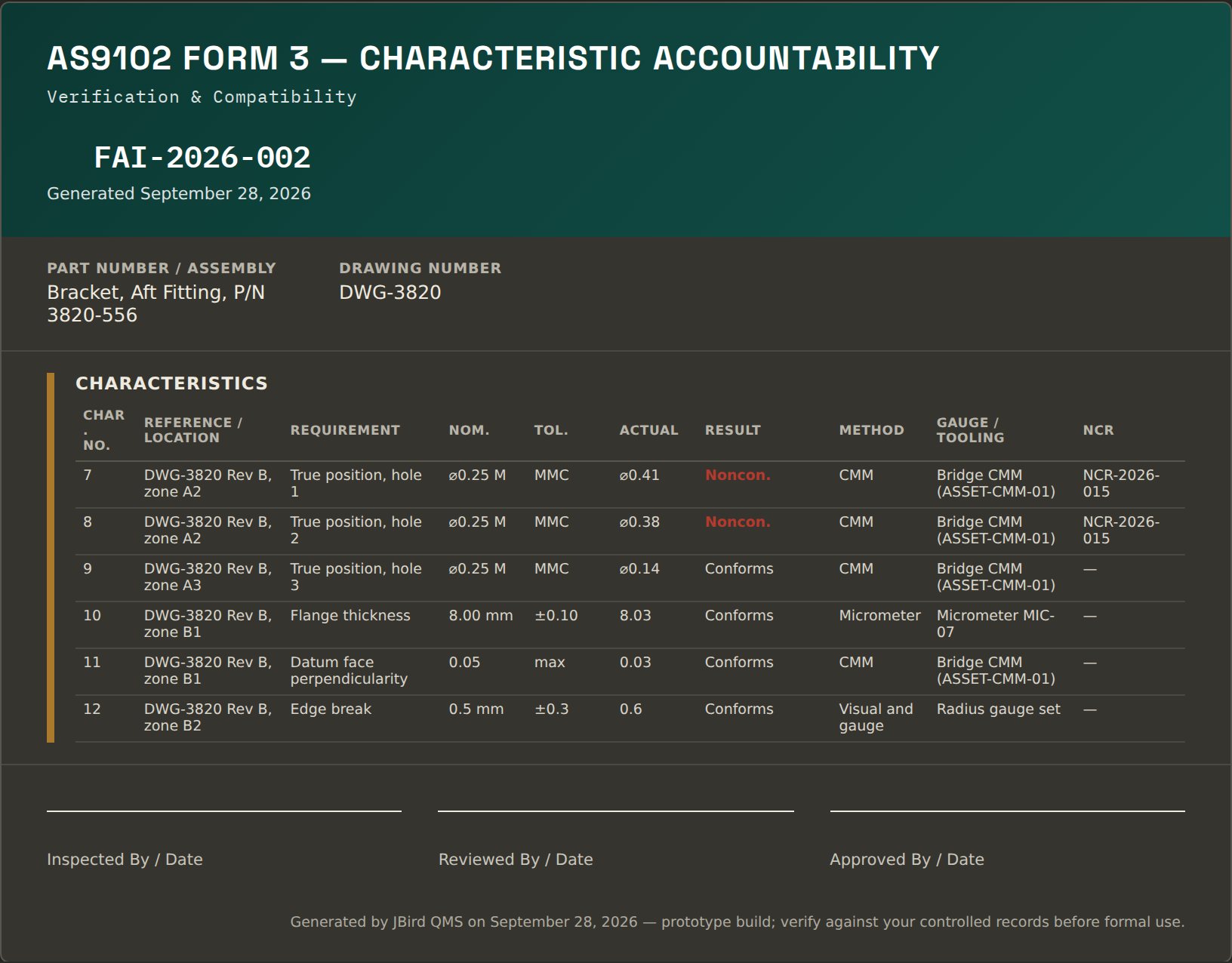
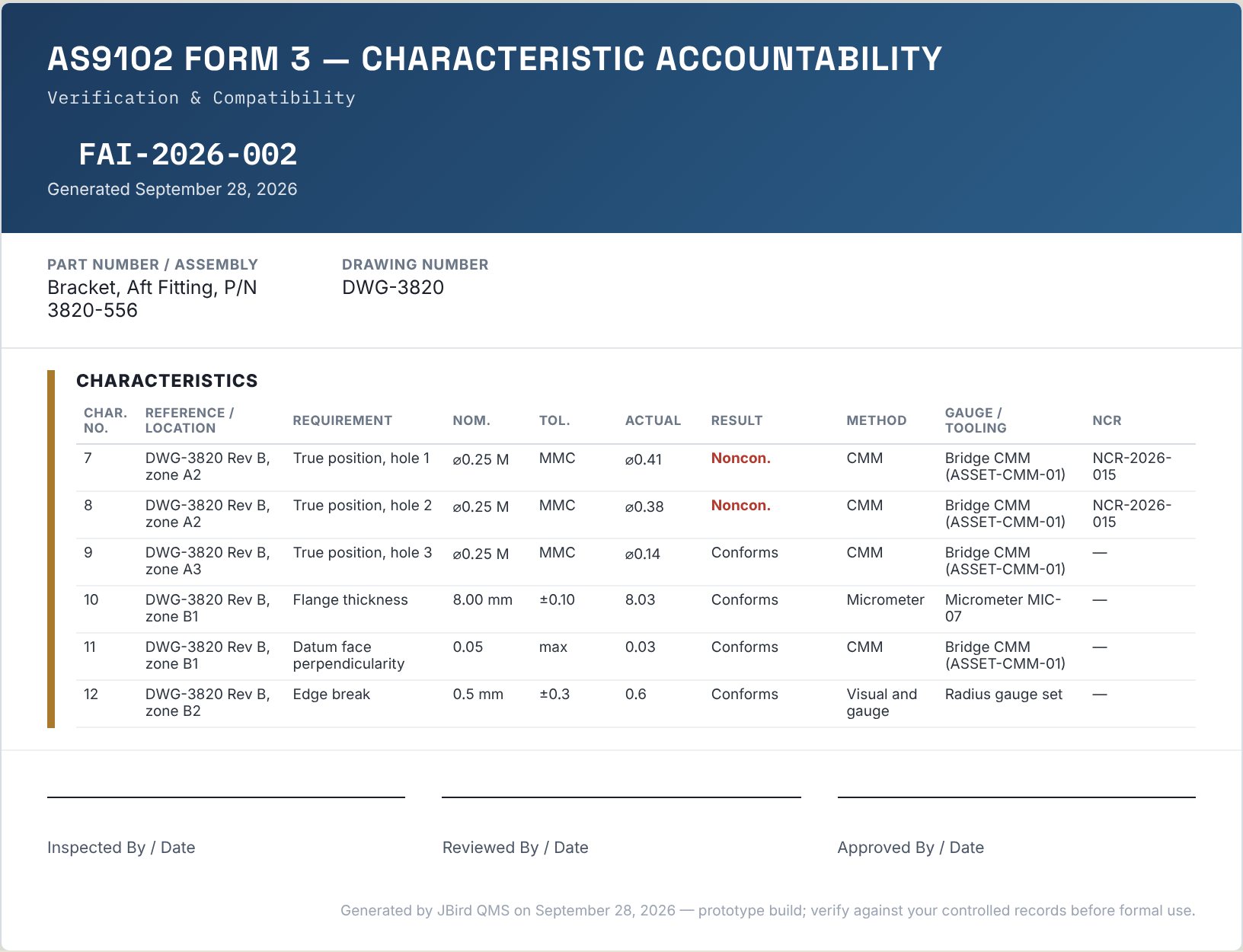
AS9102 Form 3, Characteristic Accountability, printed from the same
                    record. Six characteristics are listed by number with their drawing
                    reference and zone, requirement, nominal, tolerance, actual result,
                    conformance, inspection method and the gauge used. Two true-position
                    characteristics are marked nonconforming in red, and both carry the
                    number of the nonconformance raised against them, NCR-2026-015.AS9102 Form 3, Characteristic Accountability, printed from the same
                    record. Six characteristics are listed by number with their drawing
                    reference and zone, requirement, nominal, tolerance, actual result,
                    conformance, inspection method and the gauge used. Two true-position
                    characteristics are marked nonconforming in red, and both carry the
                    number of the nonconformance raised against them, NCR-2026-015.

Form 3 is where a first article stops being a yes or a no. Every characteristic carries what was required, what was measured and what measured it — and the two that failed carry the number of the nonconformance raised against them, which is the same NCR you can open on the NCR / CAPA tab.

Video · 0:37A narrated walkthrough of this screen: AS9102 form 3.
Read the narration

This is form 3, characteristic accountability, printed from the same record. Six characteristics. Each carries what was required, what was measured, and what measured it: the drawing reference, nominal, tolerance, actual result, method, and the gauge used. Two true-position characteristics are marked nonconforming, in red, and both carry the number of the nonconformance raised against them. The same NCR you can open on the NCR and CAPA tab. From a yes or no, to the evidence. JBird QMS.
9.2 · IAQG 9101

Your internal audit already looks like the one you're assessed against.

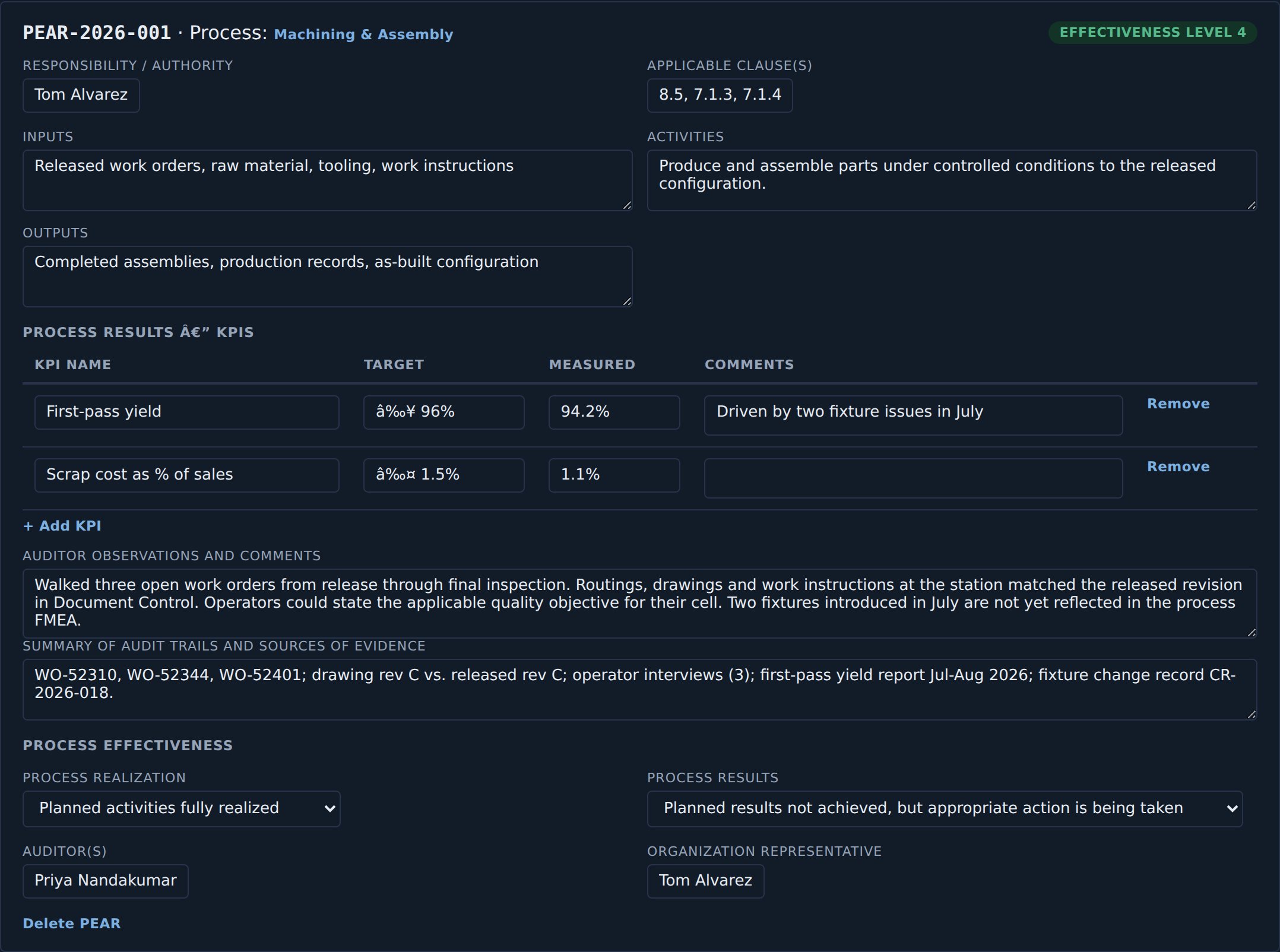
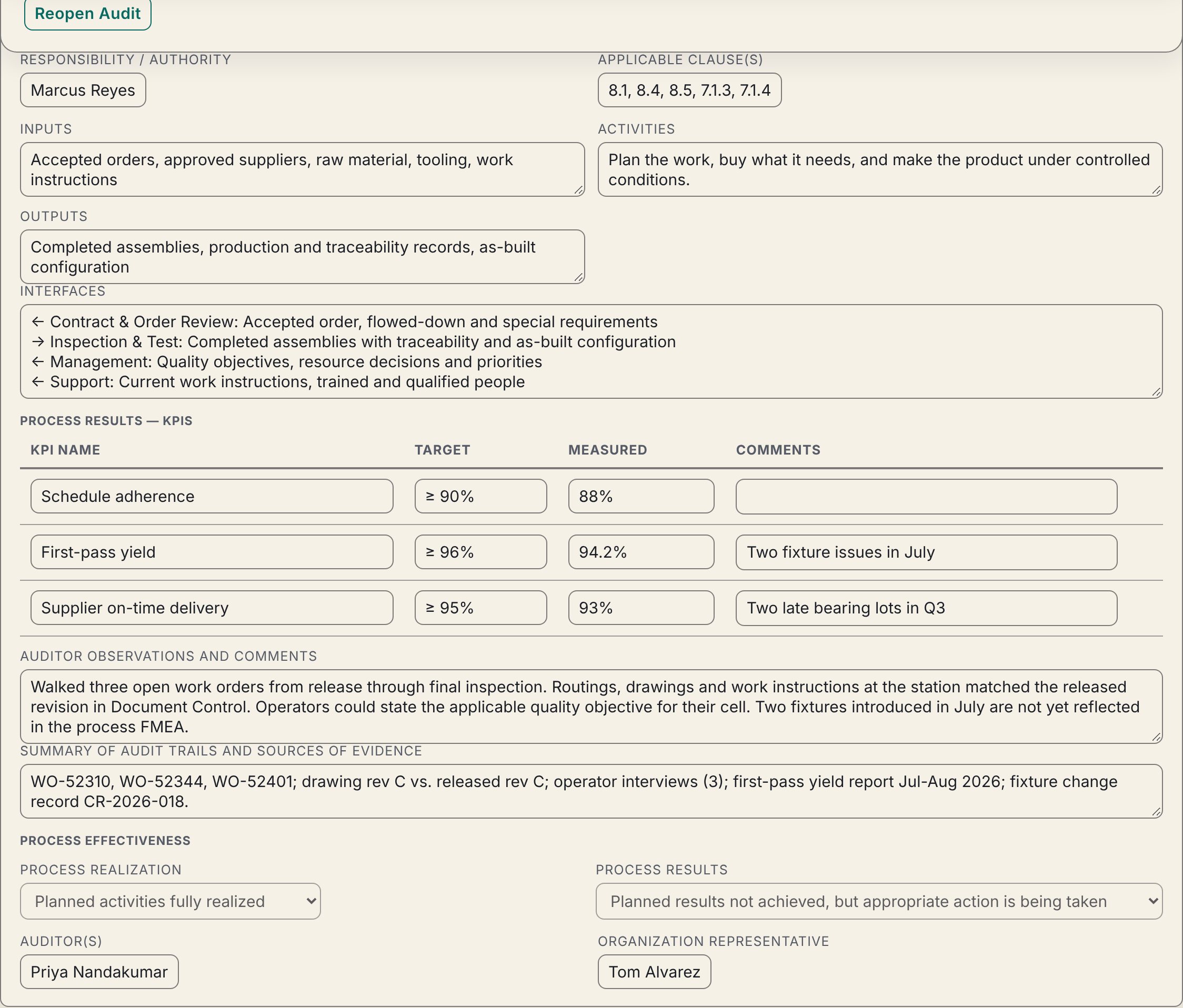
JBird runs internal audits on the actual 9101 methodology: a QMS Process Matrix marking each clause Conforming, Nonconforming, Not Evaluated or Not Applicable per process, and a PEAR per process whose inputs, activities, outputs, interfaces and KPIs come straight from your process map rather than being retyped. Process effectiveness is scored on the standard's own realization-by-results grid. If the form itself is what you're trying to understand, we wrote a full explanation of the AS9101 PEAR separately.

A PEAR in JBird with responsibility, applicable clauses, inputs, activities,
                outputs, interfaces, KPI table, auditor observations, audit trail and process
                effectiveness rating.A PEAR in JBird with responsibility, applicable clauses, inputs, activities,
                outputs, interfaces, KPI table, auditor observations, audit trail and process
                effectiveness rating.

Click to enlarge.

Video · 0:42A narrated walkthrough of this screen: A PEAR in JBird.
Read the narration

This is a PEAR in JBird, a process effectiveness assessment report, shown with sample data. It records responsibility and authority, the applicable clauses, inputs, activities, outputs, and the interfaces with other processes. The KPI table holds each target against what was measured, with comments. The auditor's observations, and the audit trail: what was walked, which work orders, and the sources of evidence. And the process effectiveness rating: scored on process realization, and on process results. Process effectiveness, on the record. JBird QMS.

8.7.1 · on a hosted pilot

"Who authorised this disposition?"

You have asked that question in an audit and been handed a record with a name in a box. The name proves nothing on its own: anyone could have typed it, including the person who wanted the answer to be yes. What you are really testing is whether the organization can show that the named person decided it, and that the decision hasn't moved since.

What the record carries

On a hosted pilot, the deciding authority on a nonconforming output is the person signed in — not a name selected from a list. Signing it means reading an attestation that is then stored on the record, acknowledging it, and re-entering your password. Wrong password, and only the attempt is recorded.

The same applies to document approval, configuration item change history, production change control and design outputs.

What happens if the decision changes

The signature is cleared. Change a disposition from rework to use-as-is after it was signed and the approval goes with it — whoever made the change has to sign again, as themselves. A record cannot sit there attesting to a decision that is no longer the decision.

And every save is logged by the database rather than by the application, so the system holds no ability to alter or erase that log — not for a user, not for an approver.

This is the hosted pilot, with named user accounts. The open demo on this site runs as a single file in your browser with no accounts at all, so it shows the original pick-a-name approver field.

On design and development

Whether 8.3 applies to you at all is the first question, and it's yours to answer. If you build to your customer's drawing and take no design responsibility, 8.3 is genuinely excludable from your scope — JBird holds that exclusion with its justification and writes it into your scope statement, so you're not explaining the same thing to every auditor. Plenty of good machine shops are in exactly that position.

If you do design product, it isn't excludable, and JBird covers it — including the continuing-airworthiness confirmation where AS9110C applies. The section below walks one released design project through the clause, sub-clause by sub-clause.

As of September 2026 there is no clause of AS9100D left on the roadmap — the last two, validation of equipment, tools and software (8.5.1.1) and information for external providers (8.4.3), closed this month. That is a claim worth reading carefully rather than taking at face value, and the product page sets out exactly what it does and does not mean: every clause has a real mechanism behind it, and none of them has yet been run by a quality manager on their own system for a year. The product page draws the line exactly →

8.3 · One released design project, top to bottom

Design records an auditor can follow without you in the room.

A design-and-build shop is a different organization from a machine shop that works to print, and its process map says so — Design & Development is a process of its own, because there are engineers doing it full time. Below is one released project in JBird: a flight-control bracket redesigned for a higher load case, shown the way clause 8.3 is written — planning, inputs, review, output, change.

A design project in JBird, collapsed: flight-control actuator mounting
                    bracket, part CD-7710, marked Released with a planning badge reading 10 of
                    10, run via the Design and Development process with a named responsible
                    engineer — above four collapsed sections for clauses 8.3.3, 8.3.4, 8.3.5
                    and 8.3.6, each showing how many records it holds, with the outputs
                    section flagging 2 critical items.A design project in JBird, collapsed: flight-control actuator mounting
                    bracket, part CD-7710, marked Released with a planning badge reading 10 of
                    10, run via the Design and Development process with a named responsible
                    engineer — above four collapsed sections for clauses 8.3.3, 8.3.4, 8.3.5
                    and 8.3.6, each showing how many records it holds, with the outputs
                    section flagging 2 critical items.
The whole project in one screenful. The planning badge counts clause 8.3.2's own a–j considerations, so “10 of 10” means all ten were addressed and each carries its note; the four sections below hold the rest of the clause and open on click.
Video · 0:42A narrated walkthrough of this screen: A design project at a glance.
Read the narration

A design project in JBird, collapsed: a flight-control actuator mounting bracket, marked released. The planning badge counts the clause 8.3.2 considerations. 10 of 10 means all ten were addressed, and each carries its note. A named engineer is responsible, and it runs through the Design and Development process. Four sections hold the rest of the clause: inputs, reviews with verification and validation, outputs, and changes. Each shows how many records it holds, and outputs flags two critical items. The whole project, in one screenful. JBird QMS.

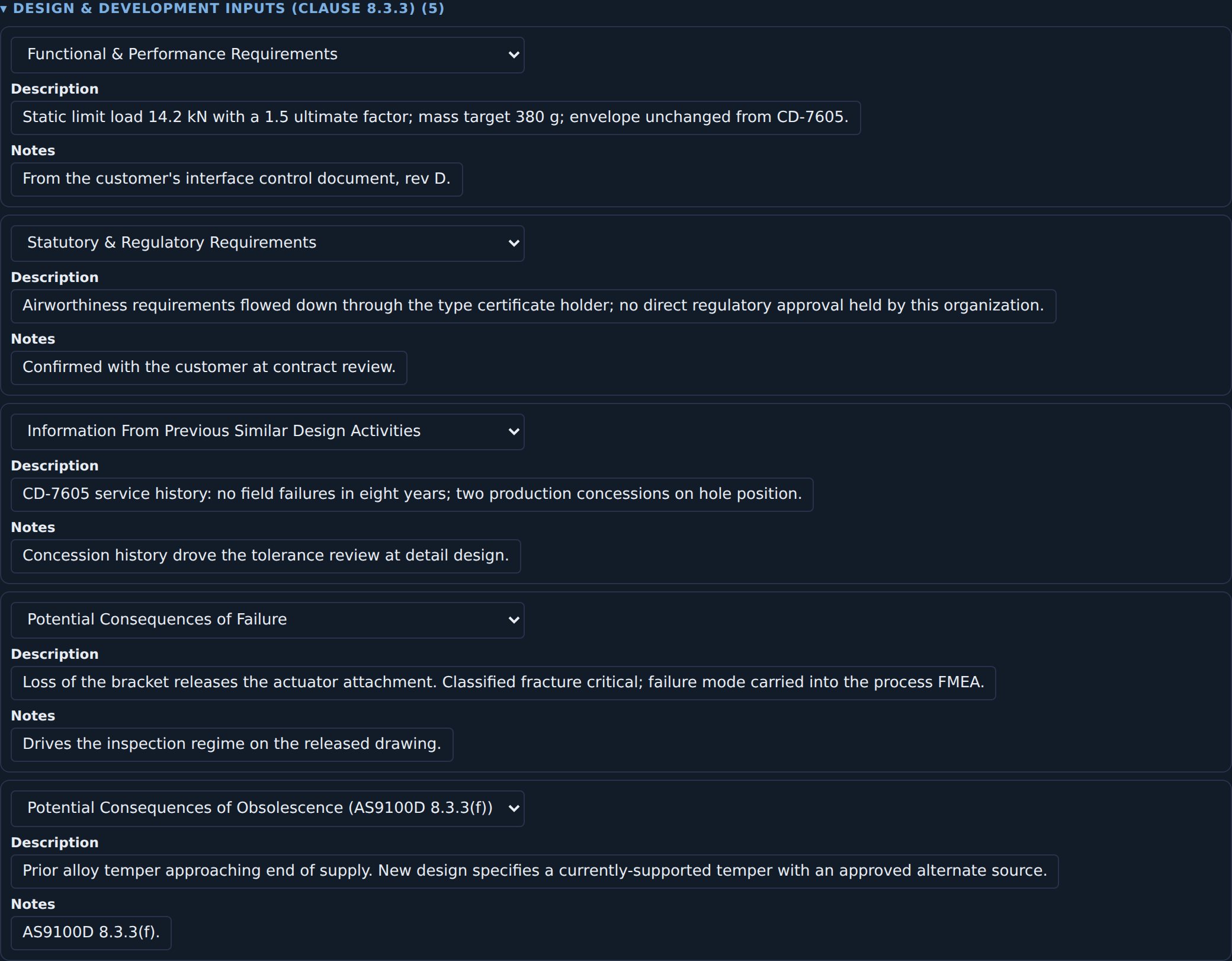
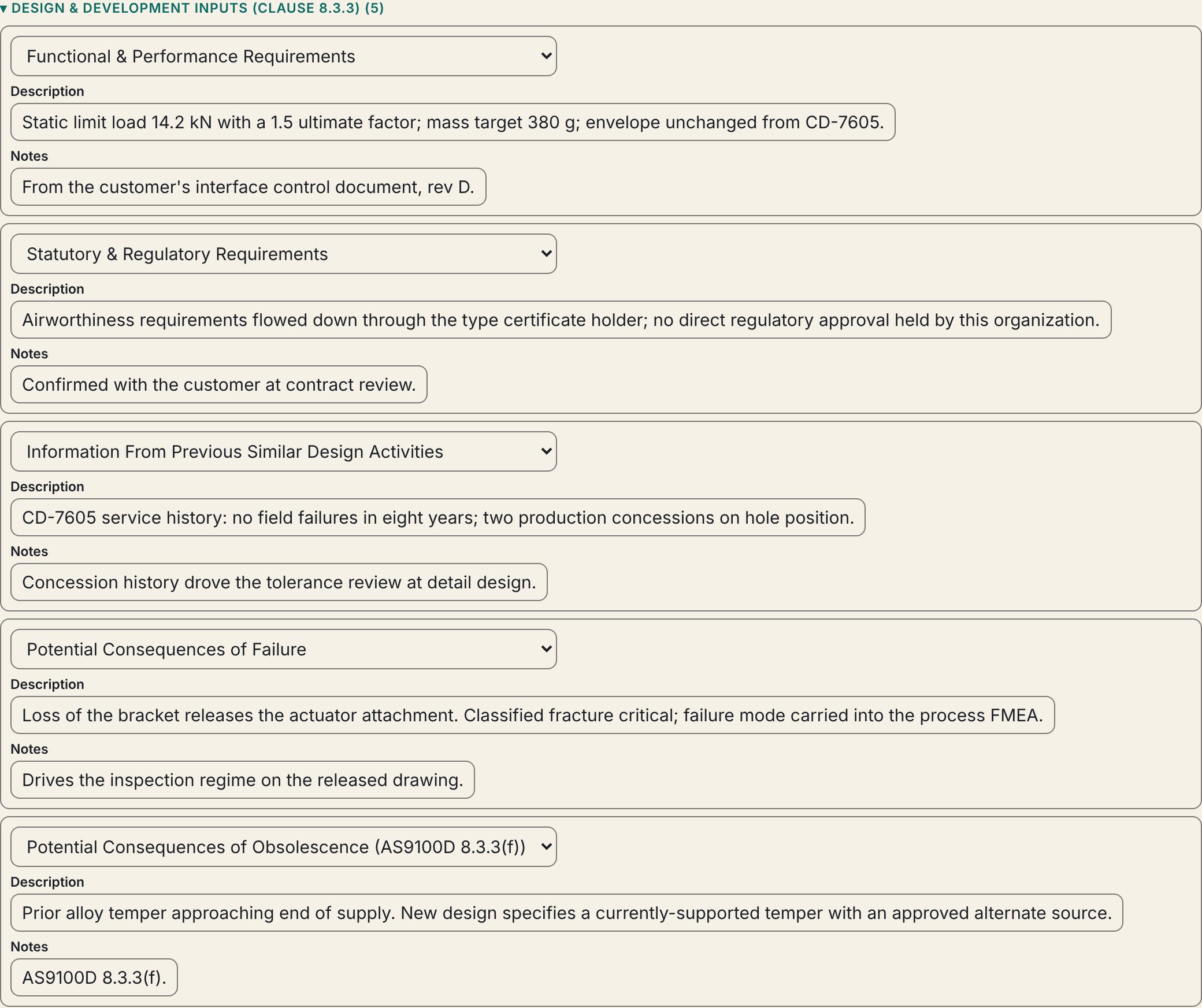
Design and development inputs in JBird, each one categorised: functional
                    and performance requirements, statutory and regulatory requirements,
                    information from previous similar design activities, potential consequences
                    of failure, and potential consequences of obsolescence — each with its own
                    description and notes.Design and development inputs in JBird, each one categorised: functional
                    and performance requirements, statutory and regulatory requirements,
                    information from previous similar design activities, potential consequences
                    of failure, and potential consequences of obsolescence — each with its own
                    description and notes.
8.3.3 — inputs are categorised in the standard's vocabulary, including the two AS9100D adds that generic tools have no reason to carry: consequences of failure, and consequences of obsolescence.
Video · 0:35A narrated walkthrough of this screen: Design inputs (clause 8.3.3).
Read the narration

Design and development inputs in JBird, each one categorised in the standard's own vocabulary. Functional and performance requirements, and statutory and regulatory requirements, each with a description and notes. Information from previous similar design activities. And the potential consequences of failure, and of obsolescence: the two inputs that AS9100D adds. Inputs, in the standard's vocabulary. JBird QMS.

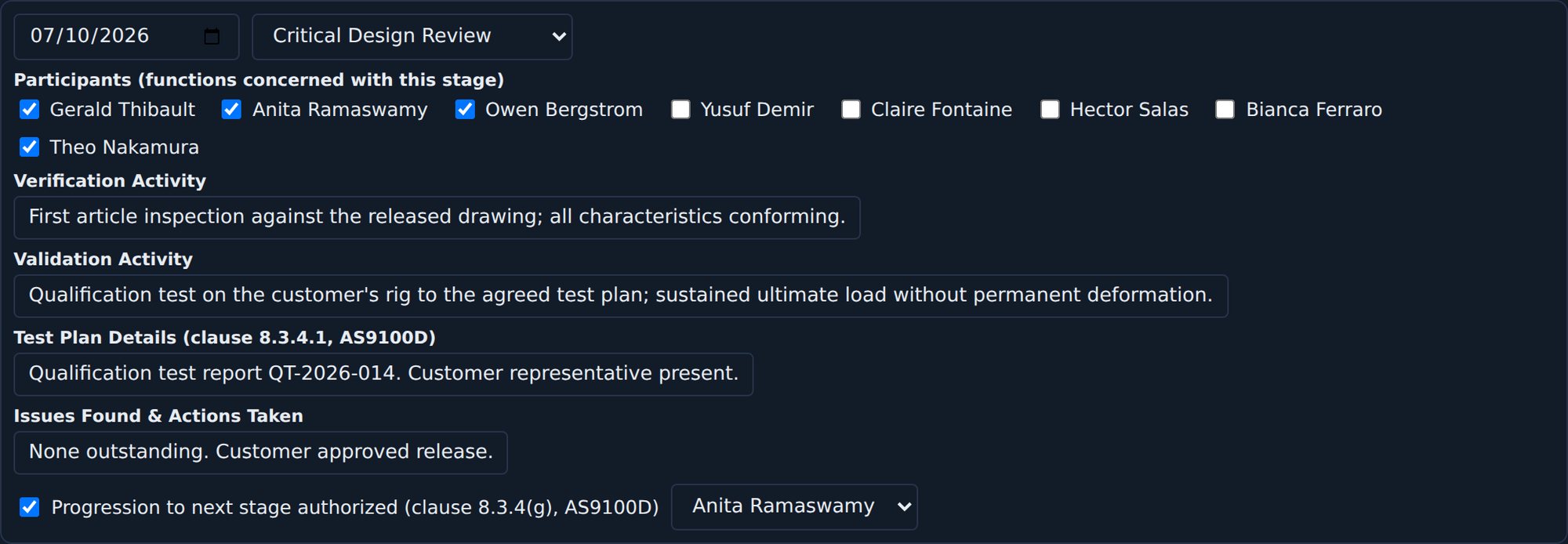
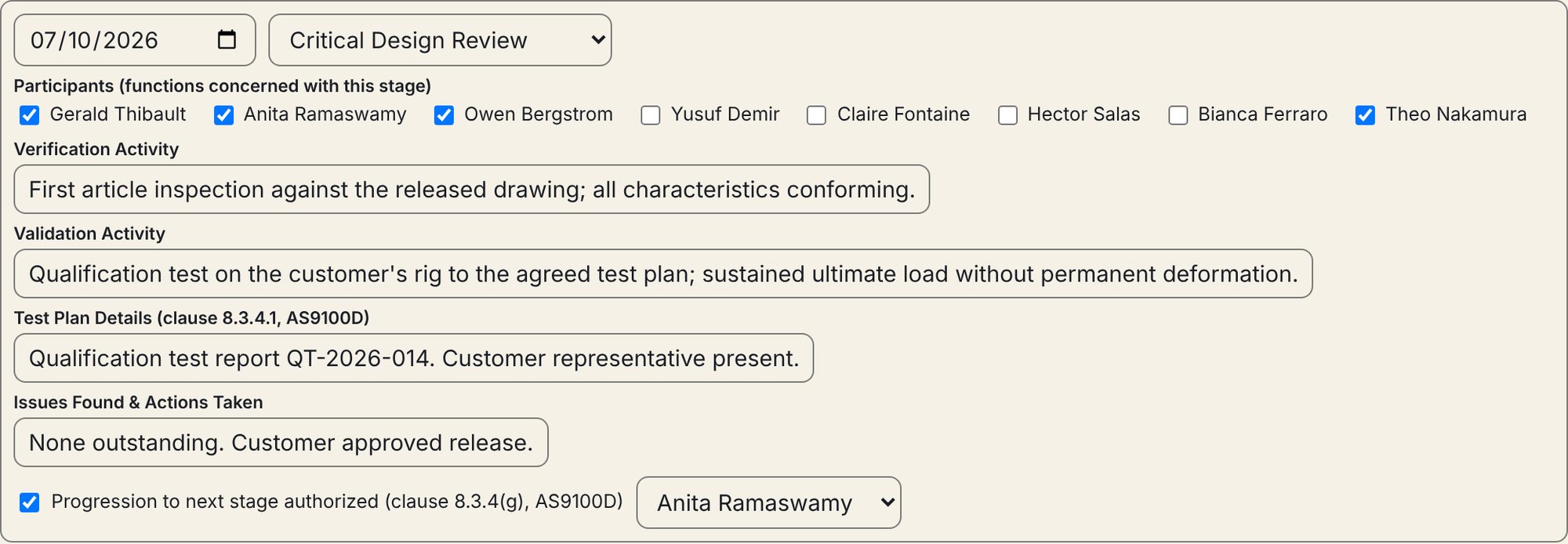
A critical design review record in JBird with its date, participants ticked
                    by name, verification activity, validation activity, test plan details and
                    a checkbox reading progression to next stage authorized, with the
                    authorizing person named.A critical design review record in JBird with its date, participants ticked
                    by name, verification activity, validation activity, test plan details and
                    a checkbox reading progression to next stage authorized, with the
                    authorizing person named.
8.3.4 — verification and validation are separate fields because they are separate requirements, and progression to the next stage is an explicit authorization by a named person, per 8.3.4(g).
Video · 0:40A narrated walkthrough of this screen: A design review (clause 8.3.4).
Read the narration

This is a critical design review record in JBird. It has the date, the type of review, and the participants, ticked by name. Verification and validation are separate fields, because they are separate requirements. Here, a first article inspection for verification, a qualification test on the customer's rig for validation, and the test plan details. And progression to the next stage is an explicit authorization, by a named person, per clause 8.3.4(g). Progression is an explicit authorization. JBird QMS.

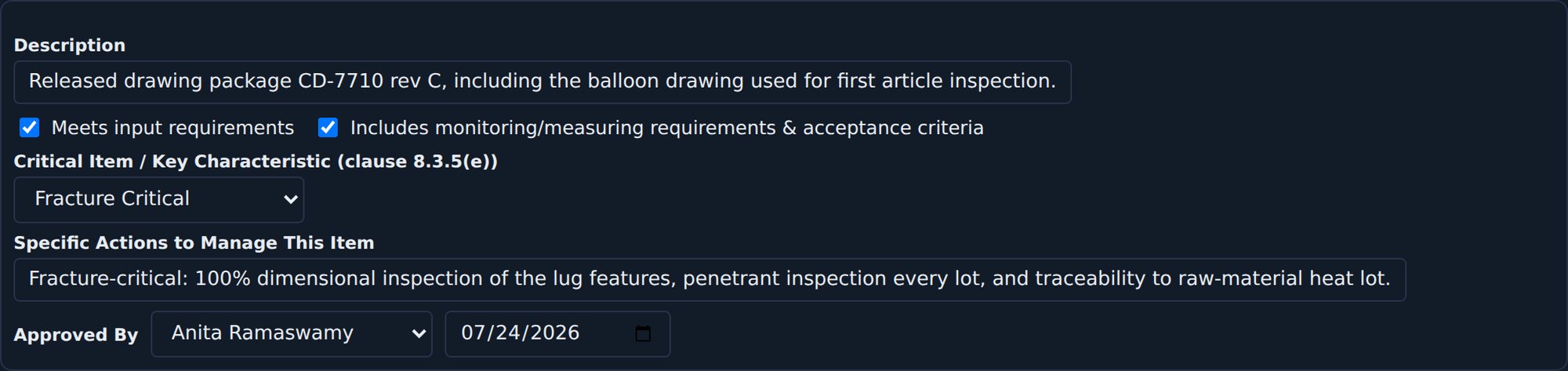
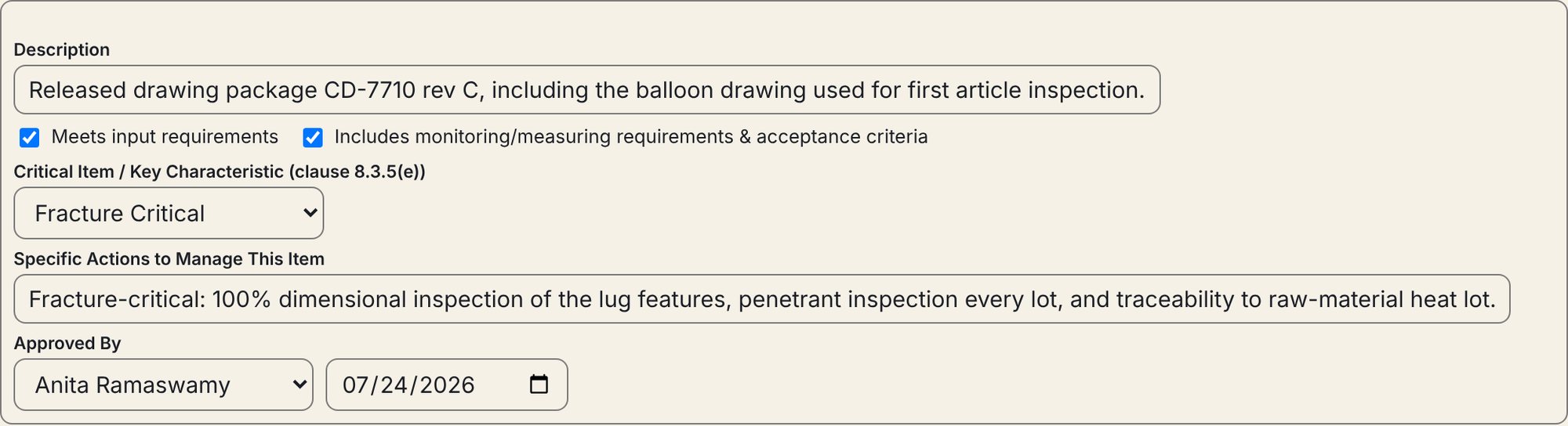
A design output record in JBird: a released drawing package marked as
                    meeting input requirements and including acceptance criteria, classified
                    Fracture Critical, with the specific actions that manage it and the person
                    and date that approved it.A design output record in JBird: a released drawing package marked as
                    meeting input requirements and including acceptance criteria, classified
                    Fracture Critical, with the specific actions that manage it and the person
                    and date that approved it.
8.3.5(e) — an output classified fracture critical, key characteristic or safety critical has to carry the specific actions that manage it. JBird makes that field appear the moment you classify it.
Video · 0:38A narrated walkthrough of this screen: A design output (clause 8.3.5).
Read the narration

A design output record in JBird: a released drawing package, marked as meeting the input requirements. It also includes the monitoring and measuring requirements and acceptance criteria. It is classified fracture critical, and the record carries the specific actions that manage it: full dimensional inspection of the lug features, penetrant inspection every lot, and traceability to the raw material heat lot. And the person who approved it, and the date. Critical items carry their controls. JBird QMS.

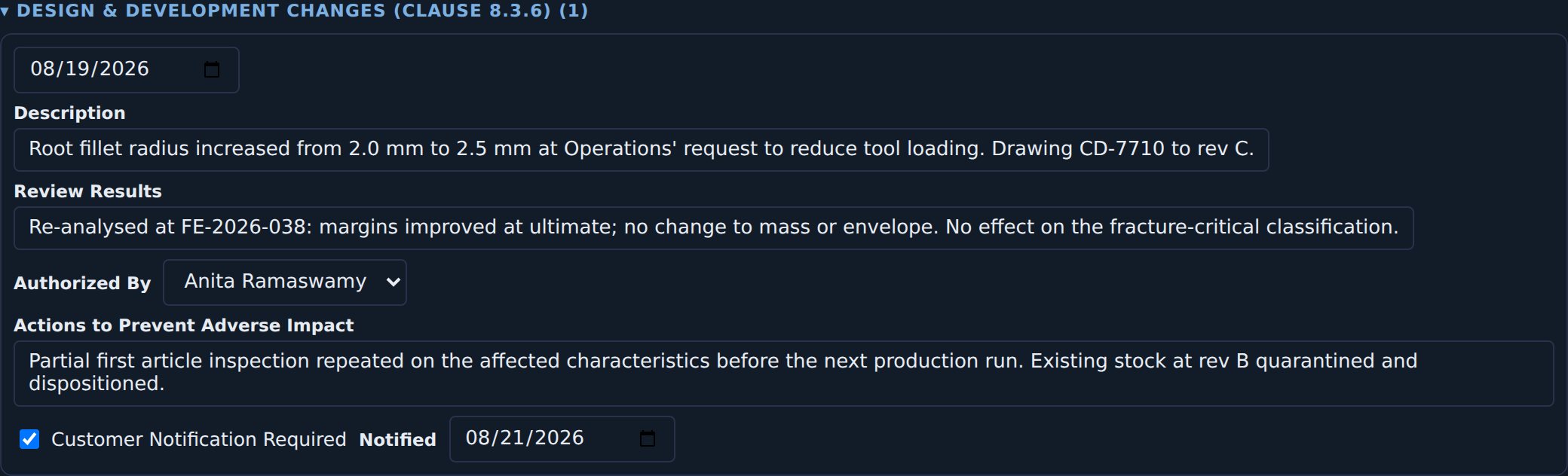
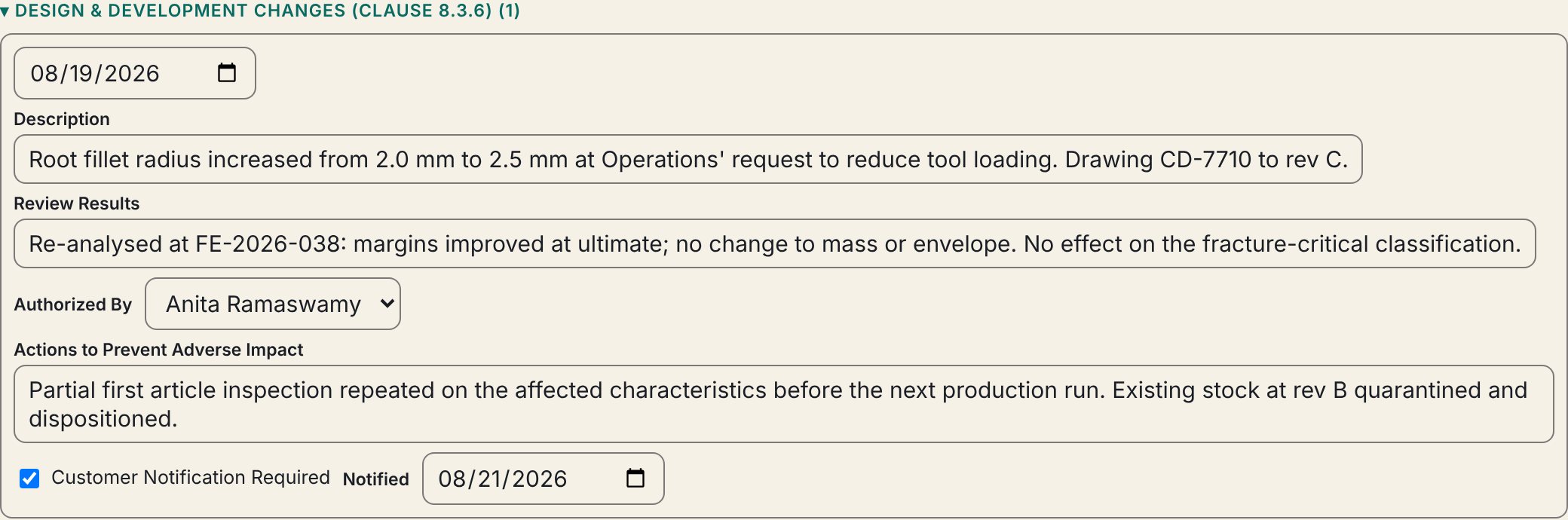
A post-release design change in JBird: the date, a description of the
                    fillet radius increase taking the drawing to rev C, the re-analysis result,
                    who authorized it, the actions taken to prevent adverse impact, and a
                    ticked Customer Notification Required box with the date the customer was
                    notified.A post-release design change in JBird: the date, a description of the
                    fillet radius increase taking the drawing to rev C, the re-analysis result,
                    who authorized it, the actions taken to prevent adverse impact, and a
                    ticked Customer Notification Required box with the date the customer was
                    notified.
8.3.6 — a change after release carries its own re-review, its authorization, and the actions taken so the change doesn't cause harm downstream. Where it affects what the customer agreed to, the notification is a tracked field rather than a remembered email.
Video · 0:36A narrated walkthrough of this screen: A design change (clause 8.3.6).
Read the narration

A post-release design change in JBird: the date, and a description of the change, here a fillet radius increase that takes the drawing to revision C. Its review results record the re-analysis, and who authorized the change. The actions taken to prevent adverse impact are recorded. And where the change affects what the customer agreed to, notification is a tracked field: required, and the date they were notified. Not a remembered email. A change carries its own review. JBird QMS.

Getting started

A machine shop's process map, not a template's.

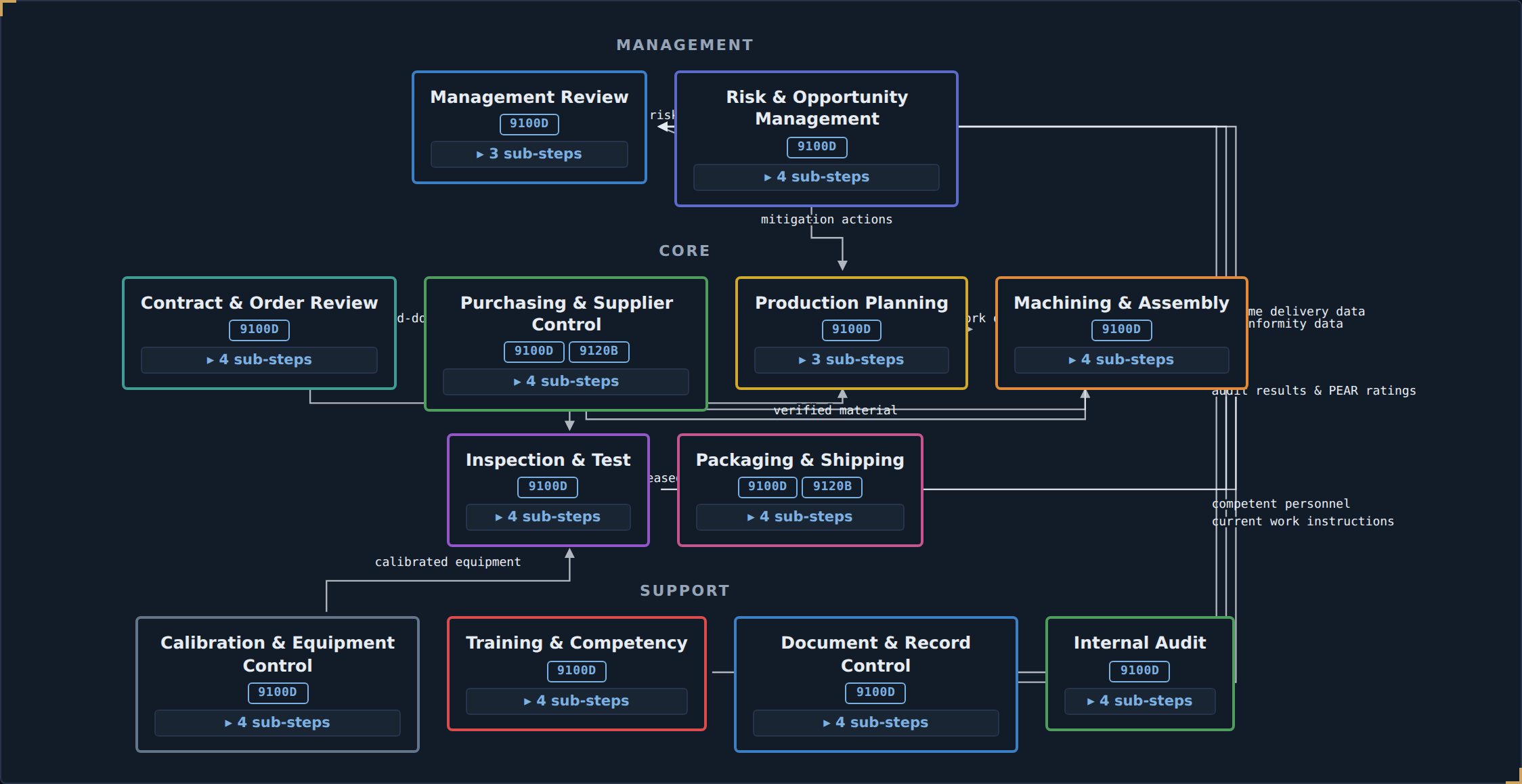
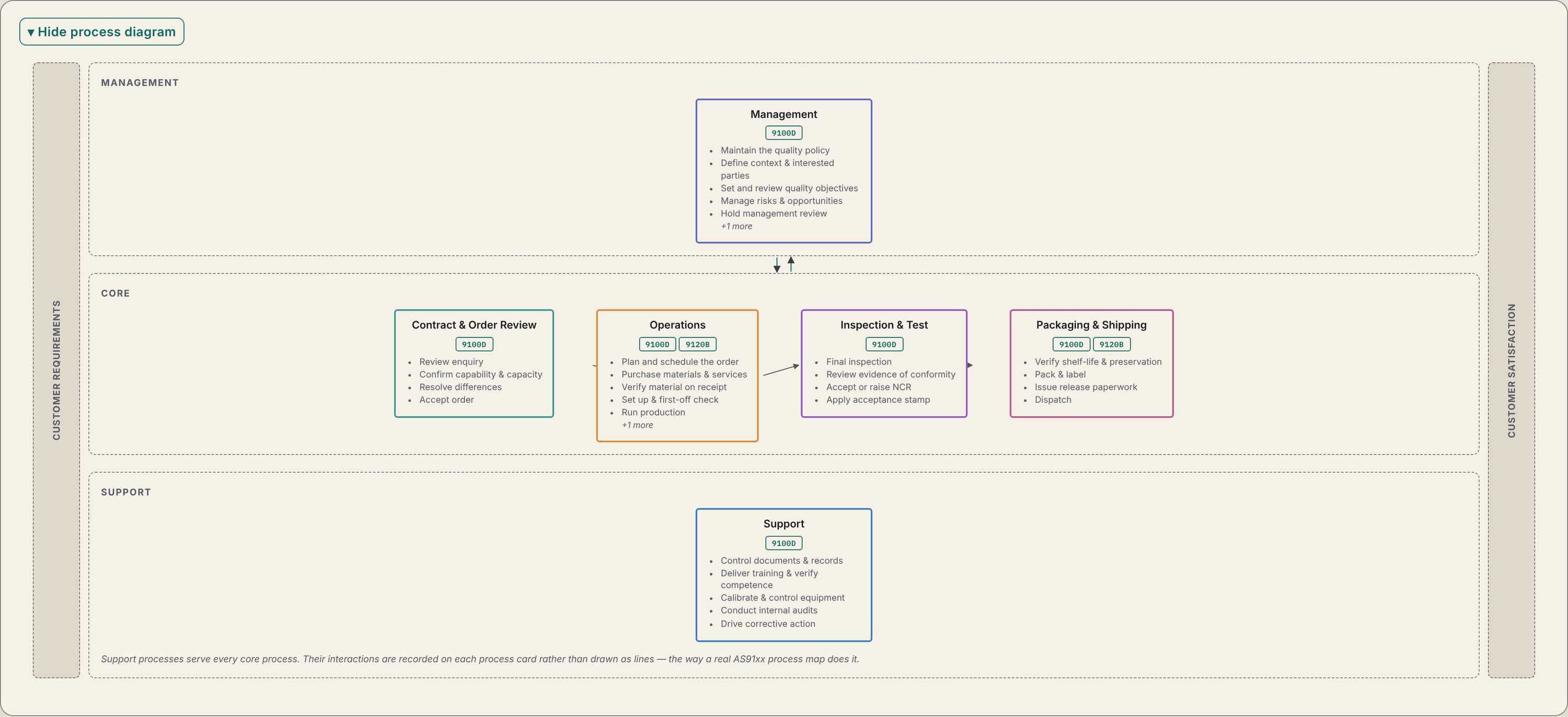
Pick the AS9100D manufacturer archetype and JBird seeds a starter map built the way a shop of your size actually runs — including the judgment that purchasing is an activity inside Operations rather than a process of its own, because most shops don't employ a purchasing manager. Then you edit it into yours.

A JBird interaction-of-processes diagram for a machining shop: one Management
                process above four core processes — contract and order review, operations,
                inspection and test, packaging and shipping — in a single left-to-right flow,
                with one Support process below.A JBird interaction-of-processes diagram for a machining shop: one Management
                process above four core processes — contract and order review, operations,
                inspection and test, packaging and shipping — in a single left-to-right flow,
                with one Support process below.

Click to enlarge.

Video · 0:46A narrated walkthrough of this screen: The interaction of processes.
Read the narration

This is the interaction of processes in JBird. It is drawn from your own data, not copied from a stock diagram. Management sits above the core, with the activities it owns: the quality policy, quality objectives, risks and opportunities, and management review. Four core processes run left to right: contract and order review, operations, inspection and test, and packaging and shipping. Each box lists its own activities. Support is drawn as a real process below the core. Customer requirements come in on the left. Customer satisfaction goes out on the right. Drawn from your own data. JBird QMS.

Pilot program

We're looking for a handful of shops to build this with.

46 modules are already built and working. Pilot organizations get the system at no cost during development, direct input on what gets built next — there is a Report a Problem button on every screen, and it goes to a register we work through — and a migration path when the IA9100 revision lands.