AS9101 · Form 3

How the AS9101 PEAR actually works.

The Process Effectiveness Assessment Report is the form your certification body fills in for every process it audits, and the one most internal audit programmes have never seen. It is not complicated. It is just specific — and the specificity is where organizations lose marks, because the form asks for things a typical process map cannot supply.

This page explains what it asks for, where each answer should already exist in your quality system, and how the effectiveness rating is arrived at. Written by a practicing aerospace QMS auditor.

First, the shape of it

One report per process, not one per audit.

This trips people up on their first surveillance. An audit of three processes produces three PEARs. Each one stands alone: it names the process, the person responsible, the clauses that apply to it, and then assesses that process on its own terms rather than against the audit as a whole.

AS9101 is the audit methodology that sits alongside AS9100D, AS9110C and AS9120B. It is what a certification body works from, and it defines a small set of forms. Form 2 is the QMS Process Matrix — a grid marking each clause Conforming, Nonconforming, Not Evaluated or Not Applicable against each process. Form 3 is the PEAR. The two work together: the matrix says which clauses were looked at and where, the PEAR says whether the process is any good.

The distinction that matters most

Conformity and effectiveness are different questions, and the PEAR is the form that asks the second one. A process can conform to every clause that applies to it — documented, followed, records retained — and still be rated as not effective, because it is not achieving what it exists to achieve. Auditors are trained to notice organizations that can only answer the first question.

What the form asks for

Four descriptive fields, then the evidence, then the rating.

The top of the PEAR is a description of the process. If your quality system already holds this, the auditor is transcribing. If it does not, they are interviewing you to reconstruct it in the audit room — which takes time you are paying for, and produces a thinner record.

Inputs

What the process receives in order to start. Not a vague category — the actual things. “Accepted orders, approved suppliers, raw material, tooling, work instructions” is an answer. “Customer requirements” on its own is not, because every process in the building could claim it.

Activities

What the process does. One or two sentences, in the organization's own language rather than the standard's. This is the field where quoting clause text back at an auditor reads worst; they can already recite it.

Outputs

What the process hands on, including the records it generates. The useful test is whether the outputs named here appear as the inputs of whichever process comes next. If they do not, one of the two descriptions is wrong, and an auditor following the chain will find the seam.

Interfaces

Which processes this one exchanges work with, in which direction, and what actually flows. This is the field most often left thin. Most process maps draw arrows between boxes without ever recording what travels along them, so the interface line becomes “Operations” rather than “from Operations: completed assemblies with traceability and as-built configuration.” The second one is an answer. The first is a diagram reference.

Process results — the KPIs

Each measure, its target, and what it actually measured. Two failure modes here. The first is having no measures at all, which makes the effectiveness rating a matter of opinion. The second is subtler and more common: having measures with targets but no monitoring plan — nothing recording how each one is calculated, how often, and when it was last analysed. Clause 9.1.1 asks for that, and a KPI whose provenance nobody can state is not evidence of anything.

Auditor observations, and the audit trail

What the auditor saw, and the specific evidence they saw it in — work order numbers, drawing revisions, interviews, reports, records. The audit trail is what makes the assessment reproducible by somebody else later, and it is the part that most rewards being written while still standing at the machine.
The part people get wrong

Effectiveness is scored on two axes, and they can disagree.

The rating is not a judgement call written in a box. It comes from a grid with realization on one axis and results on the other.

Axis 1

Process realization

Were the planned activities actually carried out? Fully realized, not fully realized, or not realized. This is the conformity-flavoured axis: did you do what you said you would do.

Axis 2

Process results

Were the planned results achieved? Achieved; not achieved but appropriate action is being taken; or not achieved with no appropriate action. This is the axis your KPIs answer, which is why a process with no measures cannot be scored honestly.

Why the second axis exists

Because a process can pass the first one and still be failing. A shop can follow its production procedure exactly, retain every record, and miss its yield target every month. Realization: fully realized. Results: not achieved. That combination does not produce a clean rating, and it should not — the point of the grid is to stop a well-documented process from hiding behind its own paperwork.

It cuts the other way too. A process that is missing its targets but has a corrective action underway with evidence behind it scores differently from one that is missing them with nothing happening. “Appropriate action is being taken” is a real distinction the form makes, and it rewards organizations that noticed the problem before the auditor did.

Preparing for it

Everything on the form should exist before the auditor arrives.

The PEAR is not really a test of your audit day. It is a test of whether your process definitions are real, because every descriptive field on it is something you should already hold.

Write the process down once

Inputs, activities, outputs and interfaces belong on the process record, not in an auditor's notebook. If they only exist in the PEAR, they are recreated from memory at every audit and they drift.

Say what flows, not just what connects

Go through your process map and, for every arrow, write the thing that travels along it. This single exercise fixes the interfaces field permanently and usually exposes two or three connections nobody can actually describe.

Give every KPI a monitoring plan

How it is calculated, how often, and the date it was last analysed. A target with no method behind it is a number, and the results axis cannot be scored from a number whose origin nobody can explain.

How JBird does it

The PEAR fills itself from the process map.

This page would be advice regardless of what we sell, and the advice holds if you do it in a spreadsheet. But it is also the reason the product works the way it does, so it is worth saying plainly what it does with the above.

In JBird, inputs, activities, outputs, interfaces and KPIs live on the process record. Open a PEAR against that process and those five fields arrive already filled — not copied, but read from the same place the turtle diagram reads from, so the two cannot disagree. The auditor writes the observations, the audit trail and the rating, which is the part that genuinely requires an auditor. Process effectiveness is chosen on the standard's own realization-and-results axes rather than a free-text box.

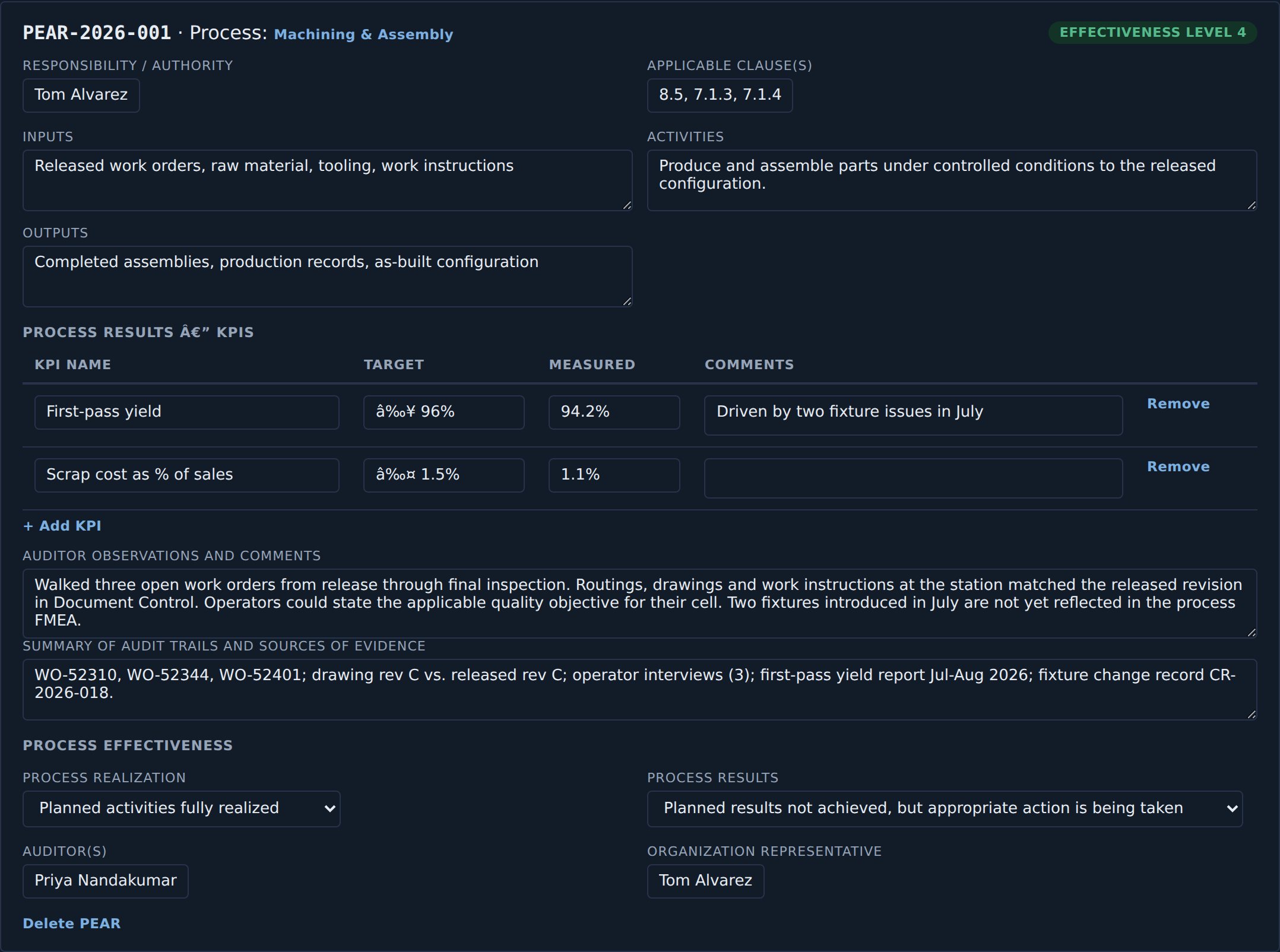
A PEAR in JBird with responsibility, applicable clauses, inputs, activities,
                outputs, interfaces, a KPI table with targets and measured values, auditor
                observations, audit trail, and process effectiveness scored on realization
                and results.

A real PEAR from the demo system. Click to enlarge, then zoom — the interfaces and KPI table are the fields worth reading closely.

Common questions

What people ask about PEARs.

What is a PEAR in AS9100?

A PEAR — Process Effectiveness Assessment Report — is Form 3 of AS9101, the audit methodology certification bodies use when they assess an AS9100, AS9110 or AS9120 quality management system. One PEAR is completed per process audited. It records what the process takes in, what it does, what it produces, who it interfaces with, how it is measured, and then rates how effective it is.

Do internal audits need PEARs?

The standard does not require you to use the certification body's own forms internally. But your certification audit will produce PEARs whether or not you have ever written one, so an internal audit programme that produces them is rehearsing the assessment you will actually face — and the first time an auditor asks how a process is performing is a bad time to discover you have never measured it.

How is process effectiveness rated on a PEAR?

On two axes, not one. Realization asks whether the planned activities were carried out: fully, not fully, or not at all. Results asks whether the planned results were achieved: achieved, not achieved but appropriate action is being taken, or not achieved with no appropriate action. The pair lands on a grid that yields the effectiveness level, so a process can follow its procedure perfectly and still be rated ineffective if it is not producing the results it was designed to produce.

What is the difference between a PEAR and a turtle diagram?

A turtle diagram is a standing description of how a process runs — it stays true between audits and changes when the process changes. A PEAR is an assessment frozen to one audit, on one date, by one auditor. They share most of their content, which is why the PEAR is quick to complete if the turtle is already accurate, and painful if it is not.

What are process interfaces on a PEAR?

The other processes this one hands work to or receives work from, and what actually flows between them. Interfaces are one of the four things a PEAR records alongside inputs, activities and outputs, and they are the field most often left thin — usually because the organization's process map shows boxes and arrows but never says what travels along the arrows.

AS9101, AS9100D, AS9110C and AS9120B are published by SAE International and the IAQG. This page explains the methodology in our own words; it does not reproduce the standards, and you need your own licensed copies. JBird is an independent product and is not affiliated with, endorsed by, or accredited by the IAQG, SAE or ISO.

Pilot program

We're looking for a handful of shops to build this with.

Twenty-eight modules are already built and working. Pilot organizations get the system at no cost during development, direct input on what gets built next, and a migration path when the IA9100 revision lands.