New ISO 9001:2026 has published. Here's what changed →

AS9100D · AS9120B · AS9110C · ISO 9001:2015

Your co-pilot for quality, compliance, and continual improvement.

JBird holds the whole quality system in one place — your process map, your manual, your audits, your calibration recall, your corrective actions — and keeps them agreeing with each other. Built by someone who audits aerospace organizations for a living.

In active development — pilot organizations wanted

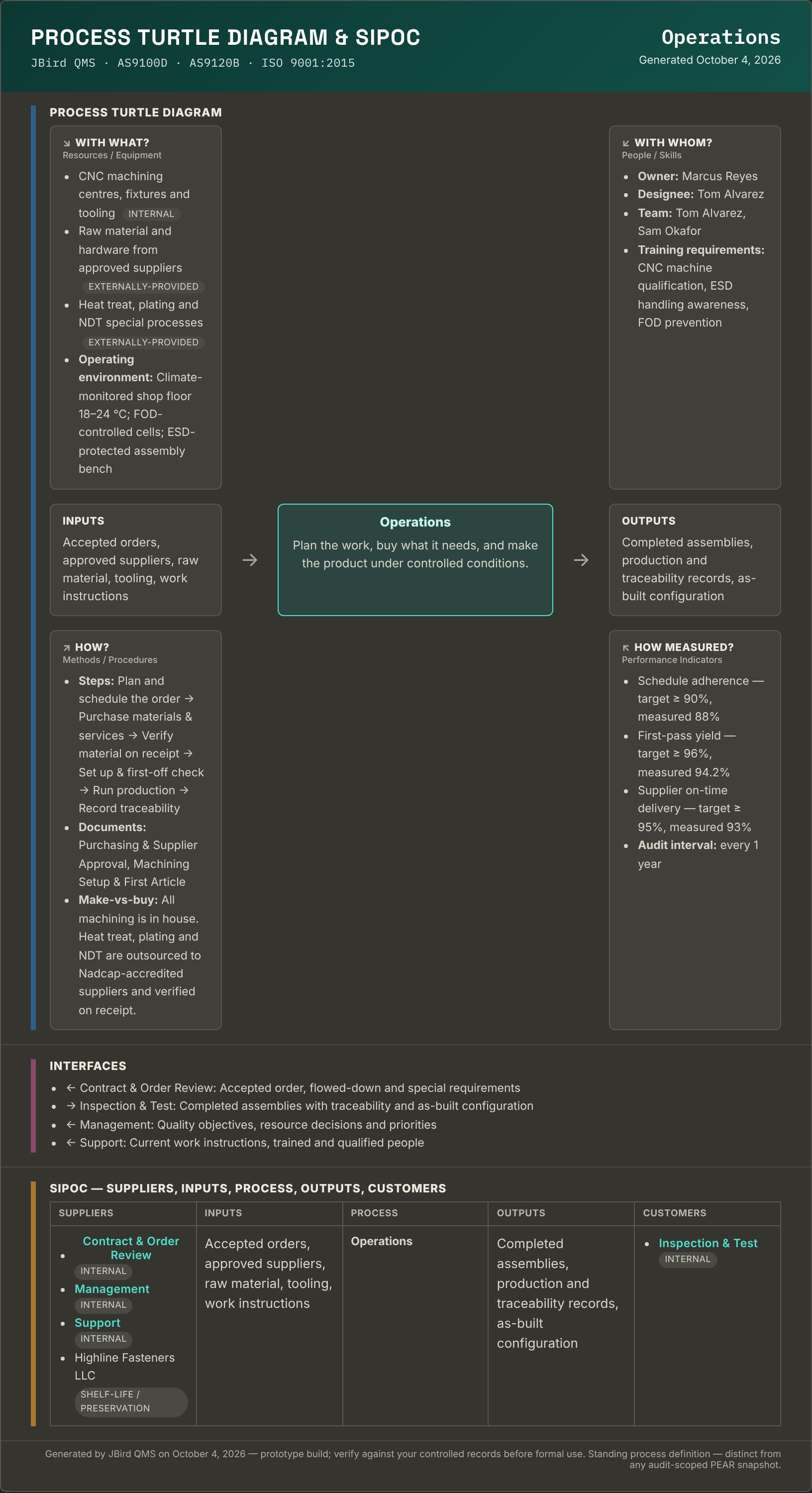
The JBird interaction-of-processes diagram: customer requirements and customer
                satisfaction bookending Management, Core and Support zones stacked top to
                bottom. One Management process above four core processes — contract and
                order review, operations, inspection and test, packaging and shipping —
                in a single left-to-right flow, with one Support process below. Each box lists
                its own activities as bullets.

The interaction of processes, drawn from your own data — not a stock diagram. Click to enlarge.

One level down

The map shows what feeds what. The turtle shows how one process actually runs.

An interaction map earns its keep by staying readable, so it only has to answer one question: which process feeds the next. The moment you start hanging inputs, outputs, equipment and metrics off the arrows, nobody can follow it — and none of that detail belongs there anyway. It belongs in a turtle diagram or a SIPOC, one process at a time.

A note on how many processes you should have

Most quality systems are drawn with too many. Management Review, Context of the Organization, Risk & Opportunity, Quality Objectives and the Quality Policy are usually activities inside a Management process, not five processes. Document control, training, calibration, internal audit and corrective action are usually activities inside Support. And plenty of shops have no Purchasing process at all — it sits under Operations, because there is no purchasing manager.

A useful rule: if nobody is primarily employed to execute an activity, it is probably not a separate process. JBird lets you split one out when you really want to — it just doesn't push you into twelve processes on day one.

That rule is in the product, not just in this paragraph. JBird's archetype library states it before you pick a starting shape, and shows it landing on opposite answers about purchasing for a machine shop and a distributor, then on a separate answer again about design for a shop that employs engineers — the same rule, applied to whoever you actually employ. See how that works →
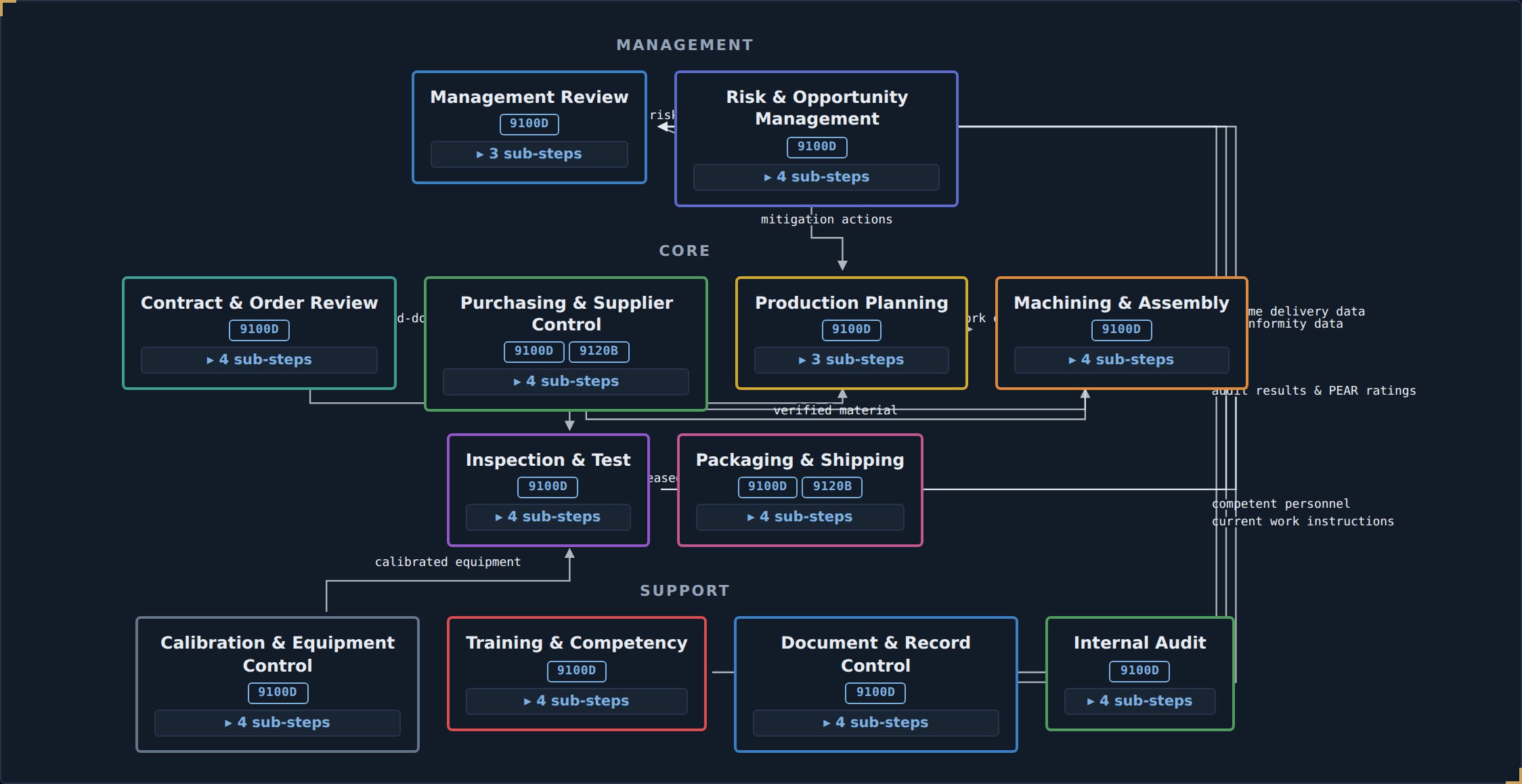
A JBird turtle diagram and SIPOC for the Operations process: With What,
                With Whom, Inputs, the process itself, Outputs, How and How Measured
                around a centre box; beneath it an Interfaces list naming each connected
                process with its direction and what flows; and a SIPOC table whose supplier
                and customer columns mix named external companies with upstream and
                downstream processes tagged Internal.

One process: every turtle leg, its interfaces, and a SIPOC — all generated from records you already keep. Click to enlarge.

Where the content comes from

Nothing on that page was typed twice. With what is the equipment and operating environment already on the process; with whom is the owner, designee and team from your people records, with their training requirements; how is the sub-steps plus the procedures and work instructions tagged to that process at their current revision; how measured is the KPIs and the audit interval. If a leg is empty, it says so — a thin process definition shows up as a gap you can find, rather than a blank box.

In the SIPOC, a supplier or customer you have actually linked — through shelf-life control, a calibration provider, a contract review — comes first by name. Where there is no real link yet, it falls back to the upstream or downstream process from your interaction map and marks it Internal, so the row is honest about which is which.

Between the two sits the process's interfaces — each one with its direction, the process on the other end, and what actually flows. That is there for a specific reason: inputs, outputs, activities and interfaces are the four things an auditor has to record on the PEAR, so the page an auditor reads is the page they can fill the form from.
Built against AS9100D AS9120B AS9110C ISO 9001:2015 IA9100 — ready for the revision

The problem

Most shops don't fail audits. They fail at finding the evidence.

The quality is usually fine. What's missing is one place where the manual, the process map, the audit record and the open corrective actions all agree with each other.

The manual is a Word file

Last revised by someone who left. Three versions float around the shared drive, and nobody is certain which one the auditor was handed last time.

The audit lives in a binder

Last year's findings, this year's checklist, and the effectiveness checks that were supposed to close them — in three places, none of them linked.

Corrective actions live in email

Root cause in one thread, containment in another, the objective evidence attached to a message from six weeks ago. The 30-day clock ran out quietly.

And the reason nobody fixes it

Most quality managers know all of this already. What stops them is the fortnight of retyping between deciding to move and having anything useful in the new system — every person, supplier, gage, document and open corrective action, keyed in by hand, on top of the day job.

So JBird imports them. A CSV out of whatever you keep now — people and training, suppliers, equipment and calibration, documents, NCR/CAPA history, customers — mapped to JBird's fields by you rather than guessed at, with a dry-run preview that shows what every row will do before a single record is written. A document with a historical approver and date gets a real dated approval record, not a badge with nothing behind it. See the import preview →

What's built

A 39-module QMS — 45 with Production — and they talk to each other.

JBird comes two ways: the quality system on its own is a 39-module build, and adding the optional Production / Operations set — bills of material, inventory, purchasing, routers, work orders and travelers — brings it to 45. Either way, define your processes once and the rest of the system inherits them. A process carries its own clauses, KPIs and owner — so an audit knows what to assess, the gap analysis knows what's covered, and a finding knows where it belongs.

Internal audit

Real IAQG 9101 methodology, not a checklist app

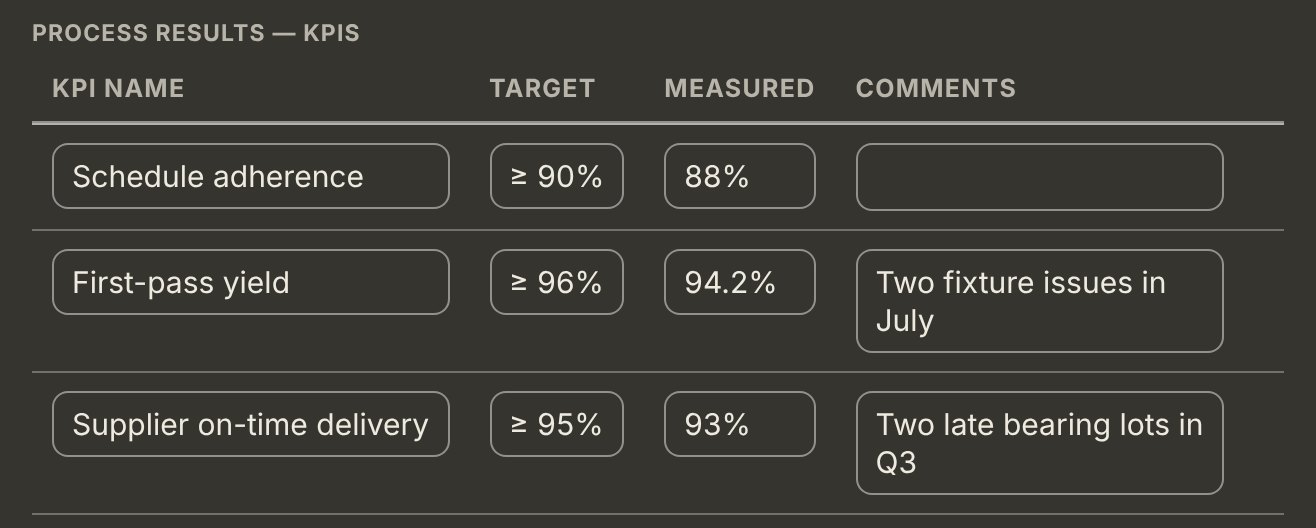
A QMS Process Matrix (9101 Form 2) marking every clause Conforming, Nonconforming, Not Evaluated or Not Applicable per audited process. A Process Effectiveness Assessment Report — the PEAR, 9101 Form 3 — for each one, scoring effectiveness from process realization and results.

  • PEAR inputs, activities, outputs and KPIs pull straight from the process map
  • Auditor's questionnaire generated per process from its documents and clauses
  • A standing personnel-awareness check against clause 7.3
  • Mark a clause nonconforming and it becomes a real NCR
The KPI table from a PEAR in JBird: schedule adherence at 88% against a 90% target, first-pass yield 94.2% against 96%, and supplier on-time delivery 93% against 95%, with the auditor's comment on each shortfall.
Process results, measured against the targets the process map set. Click to enlarge.

Readiness

Gap analysis that computes itself

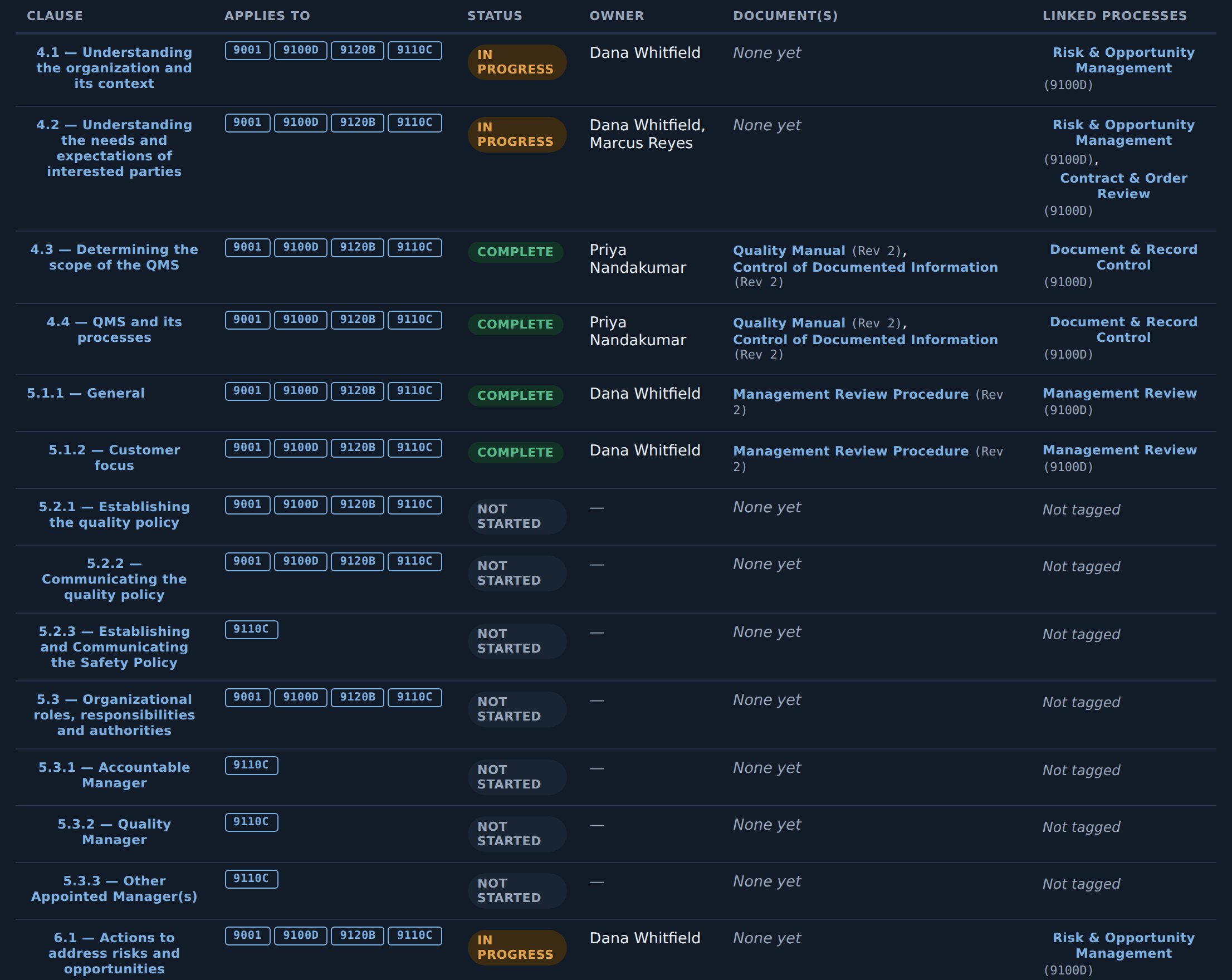
Every clause of every standard you're certified to, with its status derived from what actually exists in the system — which processes are tagged to it, which documents cover it, whether the clause summary has been written. Never a flag somebody remembered to set.

  • Filter to AS9100D, AS9120B, AS9110C or ISO 9001 alone
  • Owner, linked documents and linked processes on every clause
  • One readiness figure you can put in front of management review
JBird's clause-by-clause gap analysis table showing clause number,
                    applicable standards, status, owner, documents and linked processes.

Measurement

Calibration control that knows what it invalidated

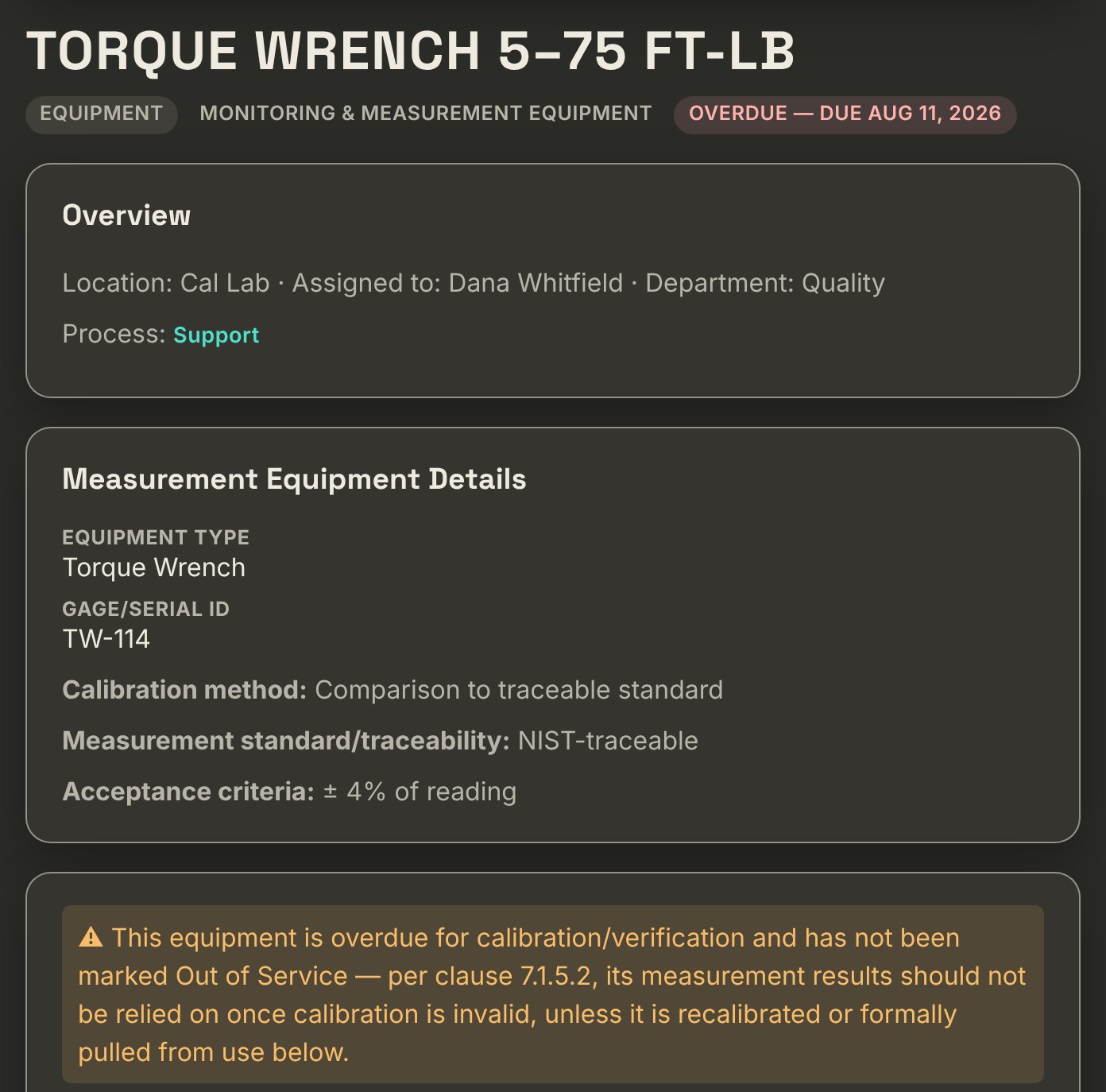
Due status is computed from the real calibration log, never a manual flag. Internal and external calibration sources, readings at multiple reference points, acceptance criteria, and a formal out-of-service quarantine log.

  • Recall list and due-soon warnings against clause 7.1.5.2
  • Out-of-tolerance findings assess impact on previous measurement results
  • An out-of-tolerance gage escalates to a real NCR in one click
A torque wrench in JBird flagged Overdue with its due date, its gage ID, calibration method, NIST traceability and acceptance criteria, above a clause 7.1.5.2 warning that its measurement results should not be relied on until it is recalibrated or pulled from service.
An overdue gage, with the clause 7.1.5.2 consequence spelled out. Click to enlarge.

Findings

NCRs and corrective actions with the clock running

Containment, root cause, correction, corrective action, effectiveness verification — in the order a registrar expects, on the timeline a registrar enforces. Root cause is worked with real tools: 5-Whys, fishbone, fault tree, Pareto and FMEA.

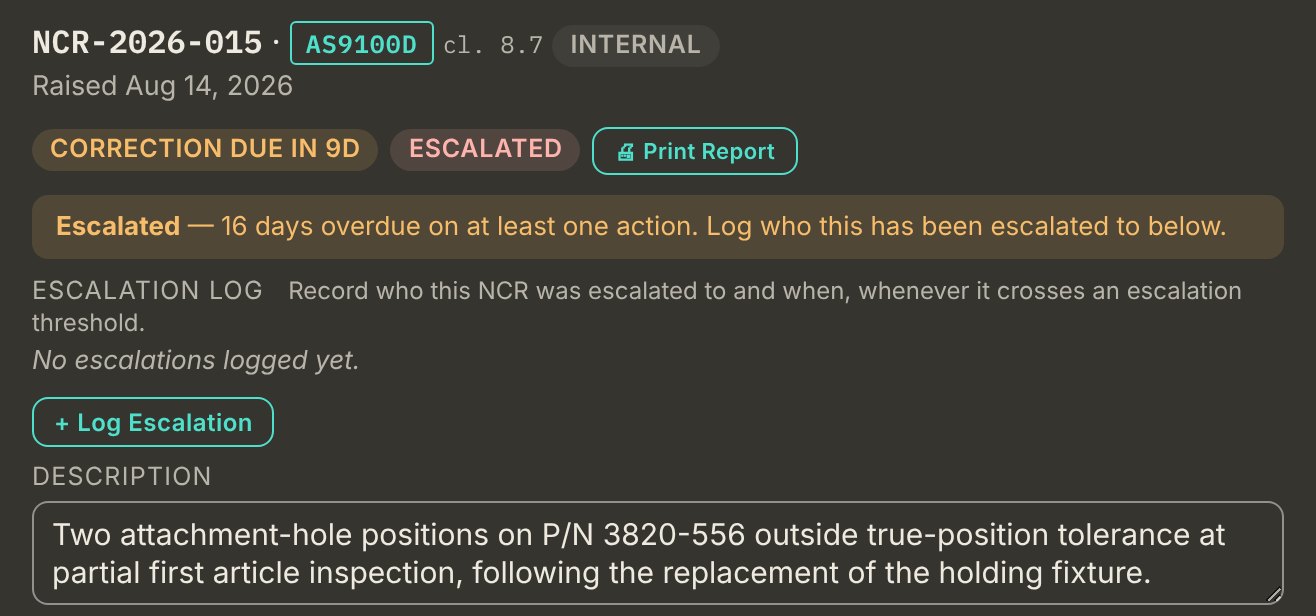
  • Deadline clocks on your registrar’s cycle — 30 and 60 days by default — with automatic escalation
  • Part number, lot, serial and work order captured for traceability
  • Recurrence detection across related nonconformances
  • Nothing closes without an effectiveness check
The header of NCR-2026-015 in JBird: raised August 14 against AS9100D clause 8.7, a correction-due countdown of 20 days, an overdue flag on the root-cause clock, an escalation log, and the description of two attachment holes out of true-position tolerance.
One NCR, both clocks running in its header. Click to enlarge.

One view

Readiness across all three sector scopes.

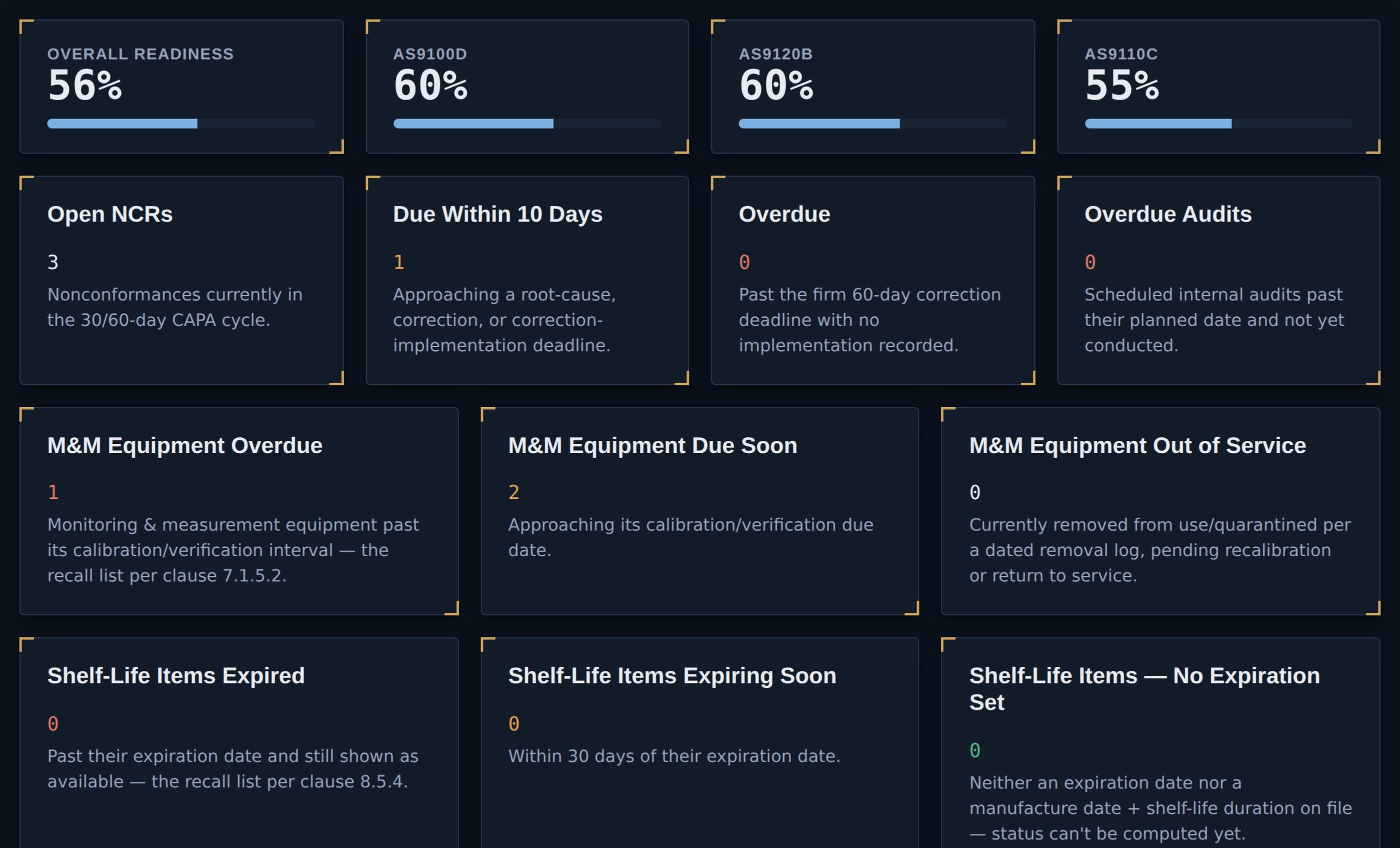
Every figure on the dashboard is computed from real records — open findings against their deadlines, equipment against its calibration log, audits against their planned dates. Nothing here is a number somebody typed in.

The JBird dashboard: overall readiness and per-standard readiness for AS9100D,
                AS9120B and AS9110C, plus open NCRs, items due within ten days, overdue items,
                overdue audits and calibration recall counts.

What's coming

The 9100 series is being revised. Twice.

The IAQG is renaming and revising the aerospace standards alongside the new edition of ISO 9001 — as two separate revisions, not one. Every certified organization transitions, and a QMS that lives in Word documents transitions the hard way.

Worth knowing

The transition window has not been announced, and the published estimates disagree — anywhere from one year to three. Aerospace transitions have historically run shorter than the three years ISO allows. Plan for less time than an ISO transition would give you, and treat any specific deadline you read online as an estimate until the IAQG says otherwise.

Clause structure is data in JBird rather than something hard-coded, so a revision is a content update and your existing clause work maps forward. Read the full 2026 changes guide →

Built by an auditor Not by a software team guessing at what a finding looks like.
Aerospace first AS9100D, AS9120B and AS9110C are the design target, not a plugin.
Sized for real shops For organizations too small for an enterprise QMS platform and too serious for a spreadsheet.

Why we're building it

“I spend my working life on the other side of the audit table. The same gaps come up again and again — not because these shops run bad quality systems, but because the system is scattered across a dozen files and nobody can see all of it at once.”

JBird is what I kept wishing the organizations I audit already had. — Founder, Quality Management Veteran’s, Inc.

Pilot program

We're looking for a handful of shops to build this with.

45 modules are already built and working. Pilot organizations get the system at no cost during development, direct input on what gets built next — there is a Report a Problem button on every screen, and it goes to a register we work through — and a migration path when the IA9100 revision lands.