AS9100D · Design and manufacture

The difference between an aerospace QMS and a relabelled one is about nine clauses.

AS9100D is ISO 9001:2015 plus a specific set of aerospace additions. Any quality tool can hold your procedures and your corrective actions. The question worth asking a vendor is what happens at 8.1.1, 8.1.2, 8.1.3 and 8.5.1 — because a generic tool with "aerospace" in the product name has no reason to have built them.

Clause by clause

What AS9100D adds, and where JBird actually stands.

Not a capability matrix with everything ticked. One of these is half done, and its card says so.

8.1.1 · built

Operational Risk Management

Risk carried through the work itself rather than a register kept alongside it, with treatments and actions that land in the master action tracker.

8.1.2 · built

Configuration Management

As-built configuration recorded against what shipped, so "which revision did we send in March" has an answer that isn't someone's memory.

8.1.3 · built

Product Safety

Safety-critical items with their criticality rationale, and a safety event log that feeds the safety-performance input management review asks for.

8.5.1.2 – 8.5.1.4 · built

Special Processes & FAI

Standing approval records for heat treat, welding and NDT with revalidation dates; first article inspections with trigger, result and disposition.

8.2.3 · 8.2.4 · built

Contract & Order Review

A review record per order against the standard's own requirements, and a change log with an acknowledgment step when the customer moves the spec.

8.5.2 · 8.6 · built

Acceptance authority media and release

Who stamped it, against what evidence, with the certification package that travels on to your customer.

8.1.4 · partly built

Counterfeit part prevention

A suspect part found at receiving raises a nonconformance with root cause and effectiveness verification like any other finding. The proactive half — the standing prevention programme — is roadmap.

8.3 · built

Design and development

Design projects with the standard's own 8.3.2 planning checklist, inputs, reviews and verification, outputs with critical items flagged, and a change log.

9.2 · AS9101 · built

Audits the aerospace way

The real IAQG 9101 Form 2 process matrix and Form 3 PEAR, with the standard's own effectiveness grid — not a generic internal-audit checklist.

The record an auditor asks for first

First article inspection, including the ones that failed.

FAI is among the most consistently sampled records in a real AS9100 audit, and "how do you handle first articles" is close to the first question a prospect asks. Each record carries the part and configuration, what triggered it, the characteristics verified, the result and the disposition.
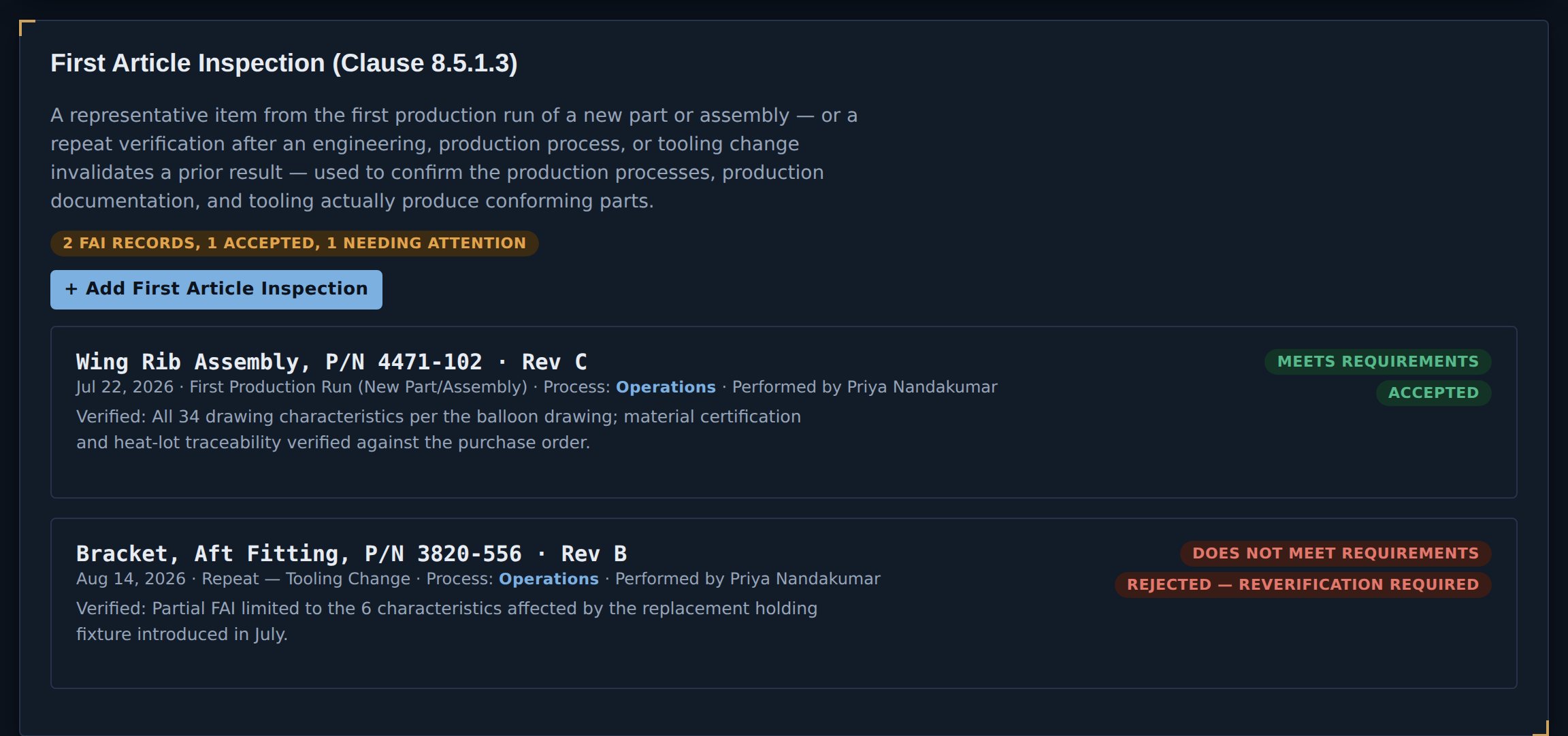
JBird's First Article Inspection panel showing two records: a wing rib
                assembly at Rev C marked meets requirements and accepted, and an aft fitting
                bracket repeated after a tooling change, marked does not meet requirements and
                rejected with reverification required.

A rejected first article isn't hidden — it's the one an auditor will ask to see. Click to enlarge.

9.2 · IAQG 9101

Your internal audit already looks like the one you're assessed against.

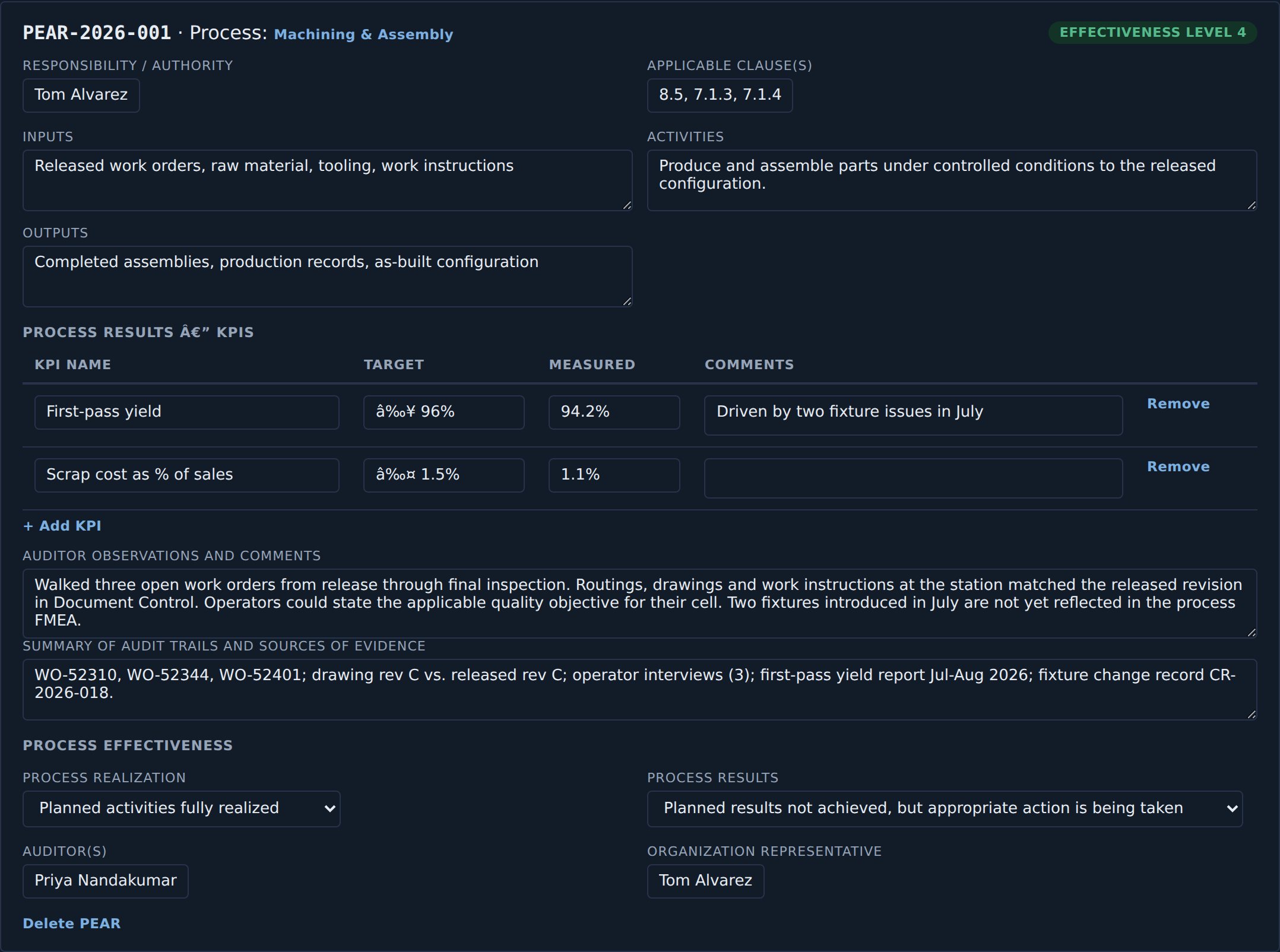
JBird runs internal audits on the actual 9101 methodology: a QMS Process Matrix marking each clause Conforming, Nonconforming, Not Evaluated or Not Applicable per process, and a PEAR per process whose inputs, activities, outputs, interfaces and KPIs come straight from your process map rather than being retyped. Process effectiveness is scored on the standard's own realization-by-results grid.

A PEAR in JBird with responsibility, applicable clauses, inputs, activities,
                outputs, interfaces, KPI table, auditor observations, audit trail and process
                effectiveness rating.

Click to enlarge.

On design and development

Whether 8.3 applies to you at all is the first question, and it's yours to answer. If you build to your customer's drawing and take no design responsibility, 8.3 is genuinely excludable from your scope — JBird holds that exclusion with its justification and writes it into your scope statement, so you're not explaining the same thing to every auditor. Plenty of good machine shops are in exactly that position.

If you do design product, it isn't excludable, and JBird covers it — including the continuing-airworthiness confirmation where AS9110C applies. The section below walks one released design project through the clause, sub-clause by sub-clause.

What's still open is smaller and named: the proactive half of counterfeit-part prevention (8.1.4), customer or external-provider property (8.5.3), and control of production changes (8.5.6). Ask us where any of them stands and we'll tell you straight. The product page draws the line exactly →

8.3 · One released design project, top to bottom

Design records an auditor can follow without you in the room.

A design-and-build shop is a different organization from a machine shop that works to print, and its process map says so — Design & Development is a process of its own, because there are engineers doing it full time. Below is one released project in JBird: a flight-control bracket redesigned for a higher load case, shown the way clause 8.3 is written.

A design project header in JBird: flight-control actuator mounting bracket,
                    part CD-7710, marked Released with a planning badge reading 10 of 10, run
                    via the Design and Development process with a named responsible engineer.
8.3.2 — the planning badge counts the standard's own a–j considerations, so “10 of 10” means all ten were addressed and each carries its note.
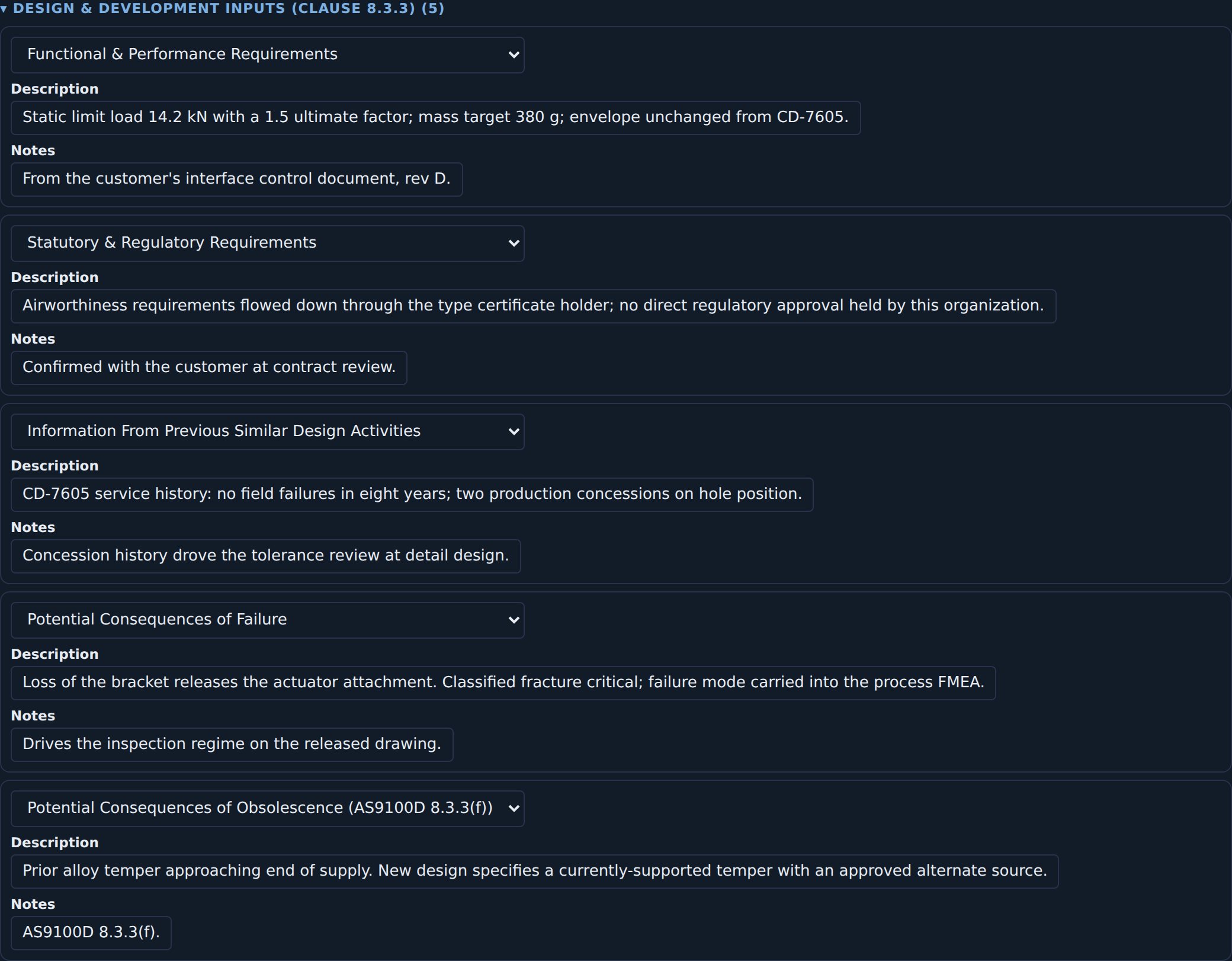
Design and development inputs in JBird, each row categorised: functional
                    and performance requirements, statutory and regulatory requirements,
                    information from previous similar design activities, potential consequences
                    of failure, and potential consequences of obsolescence.
8.3.3 — inputs are categorised in the standard's vocabulary, including the two AS9100D adds that generic tools have no reason to carry: consequences of failure, and consequences of obsolescence.
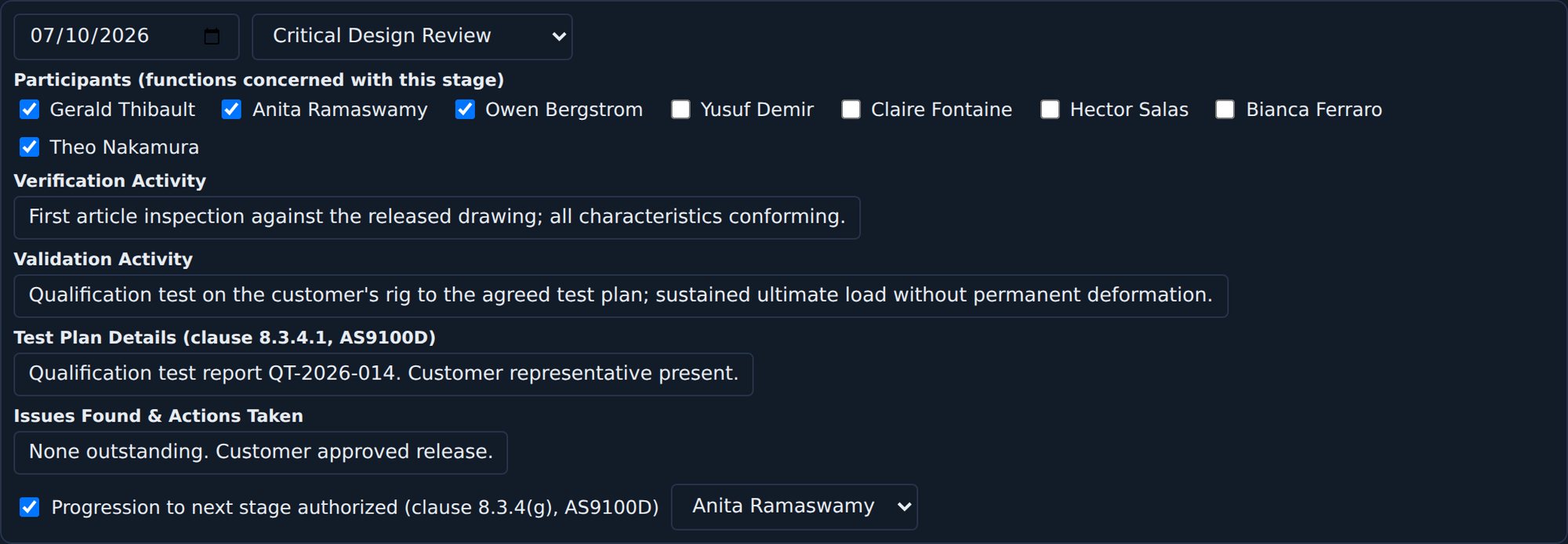
A critical design review record in JBird with its date, participants ticked
                    by name, verification activity, validation activity, test plan details and
                    a checkbox reading progression to next stage authorized, with the
                    authorizing person named.
8.3.4 — verification and validation are separate fields because they are separate requirements, and progression to the next stage is an explicit authorization by a named person, per 8.3.4(g).
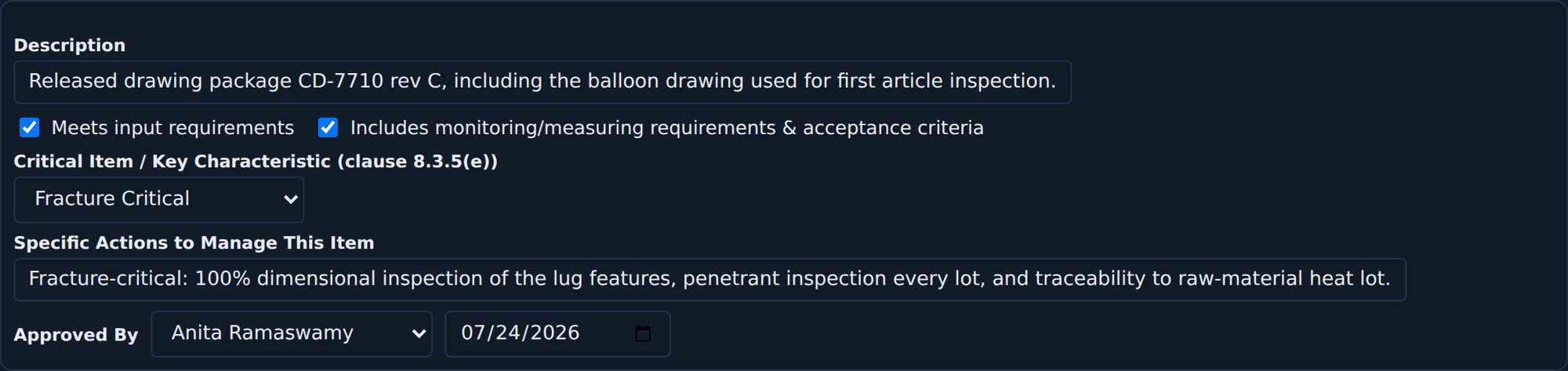
A design output record in JBird: a released drawing package marked as
                    meeting input requirements and including acceptance criteria, classified
                    Fracture Critical, with the specific actions that manage it and the person
                    and date that approved it.
8.3.5(e) — an output classified fracture critical, key characteristic or safety critical has to carry the specific actions that manage it. JBird makes that field appear the moment you classify it.

Not shown, because it is a wide table rather than a card: 8.3.6 change control — each post-release change with its re-review result, who authorized it, the actions taken to prevent adverse impact, and whether the customer had to be notified and when.

Getting started

A machine shop's process map, not a template's.

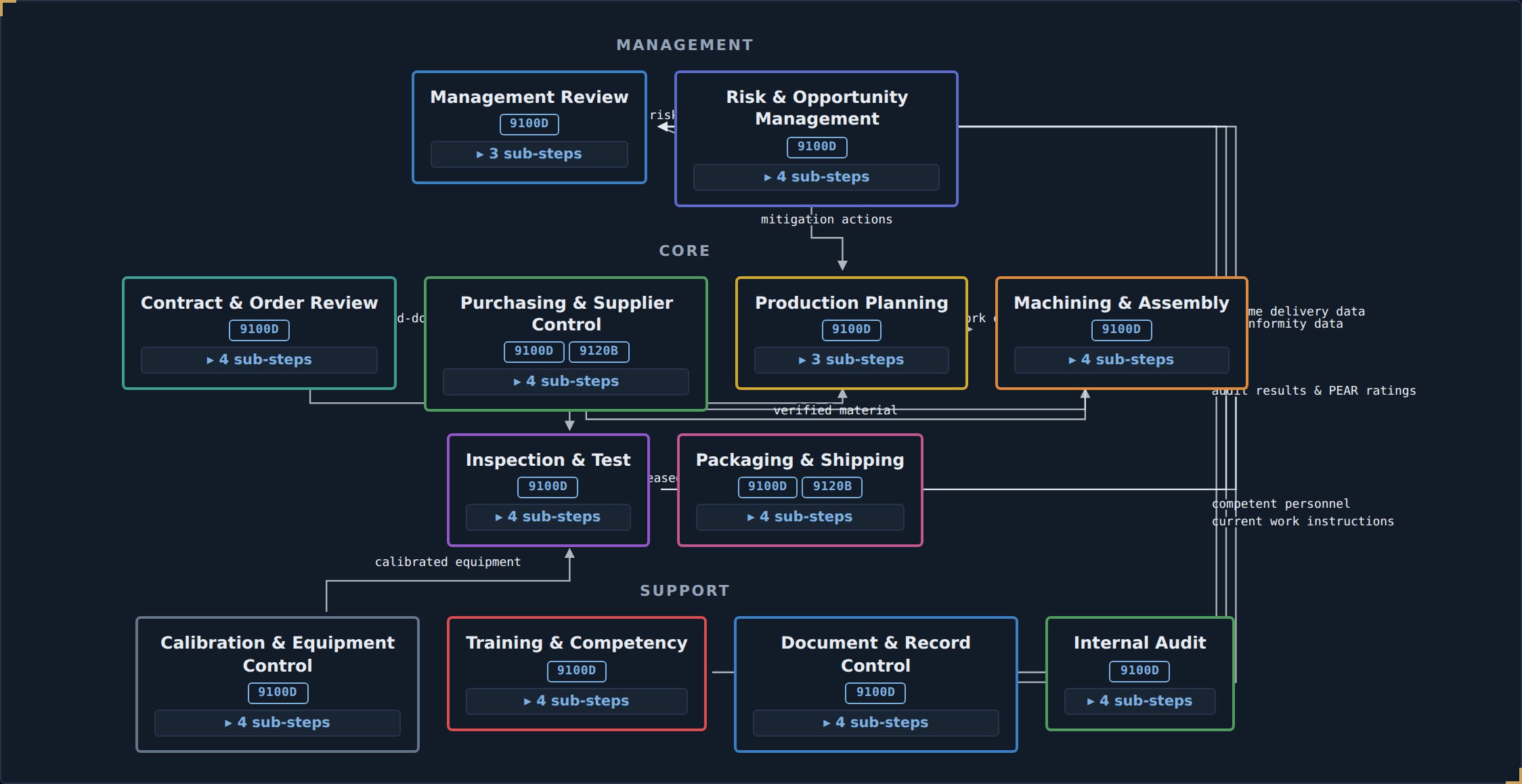
Pick the AS9100D manufacturer archetype and JBird seeds a starter map built the way a shop of your size actually runs — including the judgment that purchasing is an activity inside Operations rather than a process of its own, because most shops don't employ a purchasing manager. Then you edit it into yours.

A JBird interaction-of-processes diagram for a machining shop: one Management
                process above four core processes — contract and order review, operations,
                inspection and test, packaging and shipping — in a single left-to-right flow,
                with one Support process below.

Click to enlarge.

Pilot program

We're looking for a handful of shops to build this with.

Twenty-eight modules are already built and working. Pilot organizations get the system at no cost during development, direct input on what gets built next, and a migration path when the IA9100 revision lands.