Product
Define how your organization runs. Resource it, document it, verify it, improve it. Each stage feeds the next: define a process once and the audit, the gap analysis, the calibration register and the corrective actions all inherit it.
What your organization does, who it does it for, and what it has committed to. This is where onboarding starts — and JBird starts empty on purpose, because no two organizations map the same way.
Step 1 · the landing tab
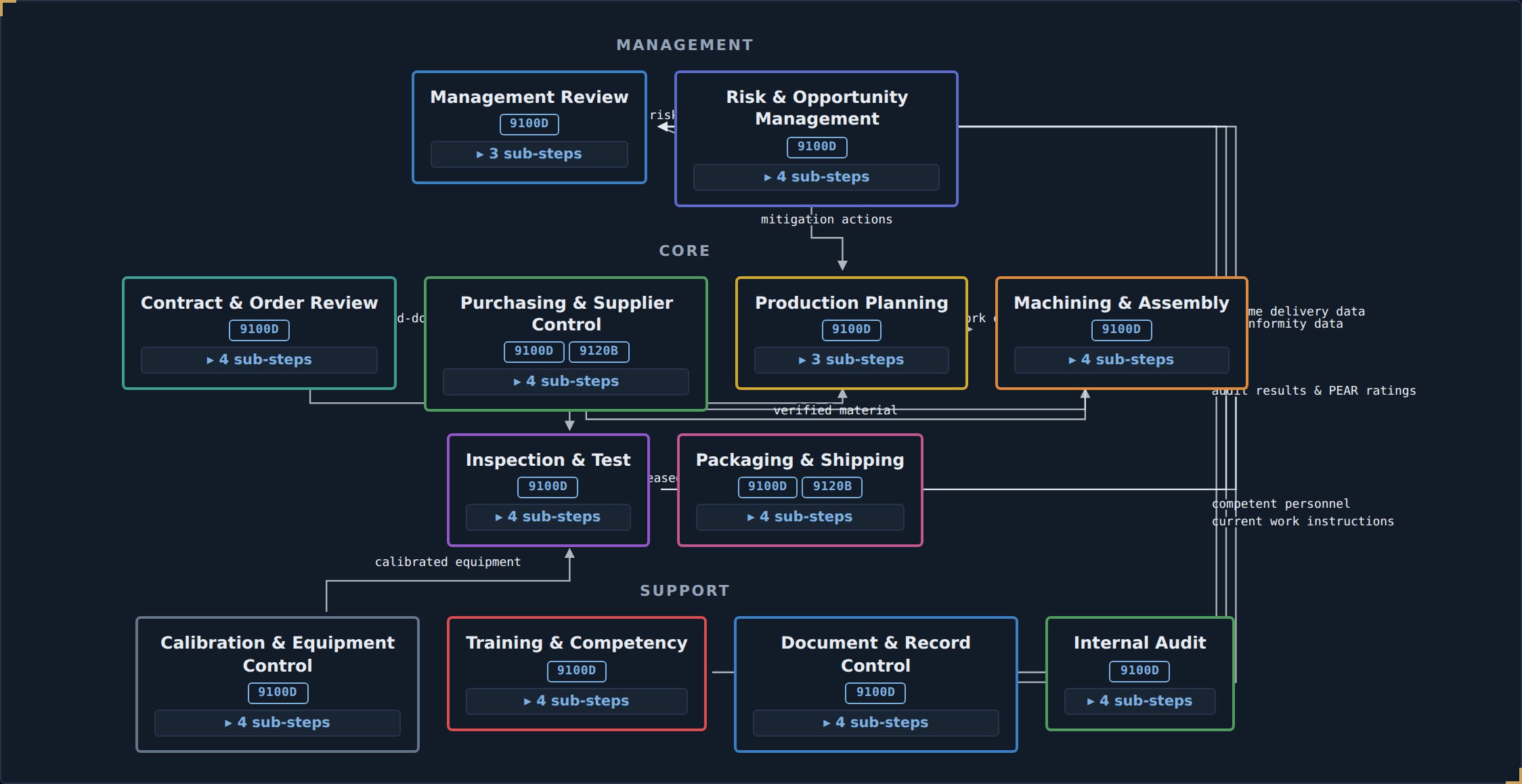
A builder, not a fixed diagram. Add your processes, group them into categories you control, and define what flows between them. The diagram draws itself from that data — connectors are routed by measuring the real rendered boxes, so a line never cuts through an intermediate process.
Each process carries the three legs of the turtle diagram an auditor expects — Inputs, Activities, Outputs, all required — plus its owner, its applicable standards and clauses, its KPI table, its audit interval, and the training its team needs. Everything downstream reads from here.
Issues log, interested parties with stakeholder mapping and RACI, and the QMS scope with the 9101 not-applicable justification cross-check.
Every customer, statutory, regulatory and internal requirement you've taken on, with where it came from and what satisfies it.
Objectives with a cascade view down to the process KPIs that actually measure them, referenced to the real SCMH 7.11.2 source.
Assessment and treatment, with actions that land in the master Action Tracker rather than dying in the register.
Planned changes to the QMS with their risk assessment, so clause 6.3 isn't a paragraph in the manual with nothing behind it.
Both registries, with supplier approval status and scope, and bulk import when you're bringing an existing list across.
The clause 7 family — the people, equipment and knowledge the processes need in order to work.
7.1.3 · 7.1.5
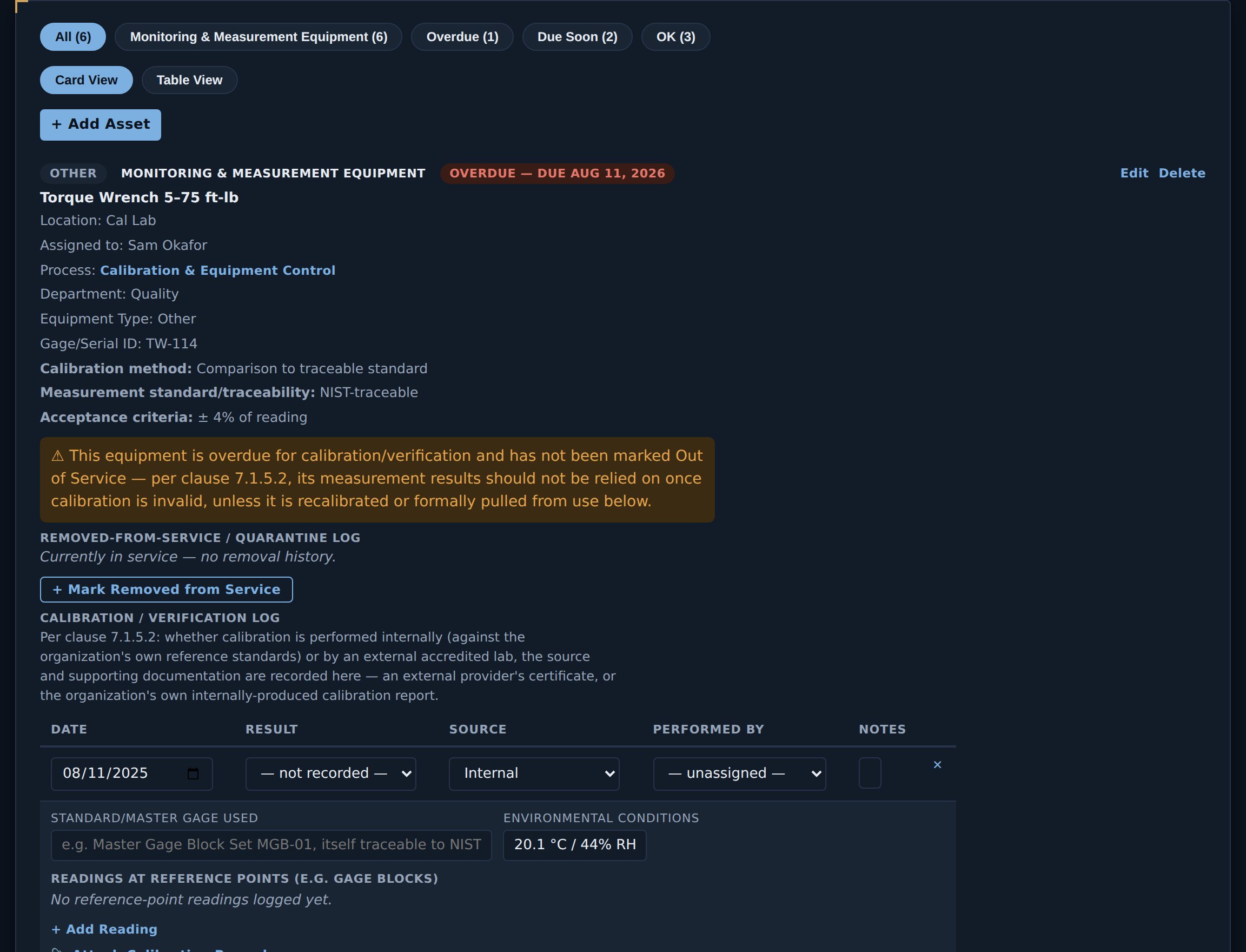
Flag anything used to verify conformity as monitoring and measurement equipment and JBird tracks its whole calibration life: interval, method, traceability, acceptance criteria, and readings at multiple reference points for internal calibrations.
Due status is computed live from the calibration log — never a manually-set flag. Overdue equipment carries a clause 7.1.5.2 warning, an out-of-tolerance finding prompts an impact assessment on previous measurement results, and a formal out-of-service quarantine log records what was pulled and when.
Your organization chart, plus roles, responsibilities and authorities mapped to the clause 5.3 requirements they satisfy.
Training roles, records and effectiveness — including the per-process competency requirements defined on the process itself.
What the organization knows and how it gets it, with a repeatable review log for clause 7.1.6's "changing needs and trends".
Time and condition-limited stock with expiration computed live — from an explicit date, or a manufacture date plus a shelf-life duration — using the same due/overdue discipline as calibration. Never a flag somebody remembered to set. Matters most for AS9120B stockists.
Documented information under control — which is where a surprising share of findings start.
Procedures, work instructions, forms, policies and scope statements with revision history, approval state and links to the process they belong to.
Retention periods per document, with eligibility computed rather than tracked by hand on a schedule nobody revisits.
Clauses 4 through 10 with the AS9100D, AS9120B and AS9110C sector requirements in place, each clause showing its linked processes and documents. Editable where your wording should differ from the template.
Where JBird is furthest ahead of a spreadsheet — and where the 9101 methodology actually shows up.
9.2 · IAQG 9101
An audit programme with a configurable multi-year cycle, per-process audit intervals, and coverage computed from real completed-audit history — so "which processes are overdue for audit" is a fact, not a guess.
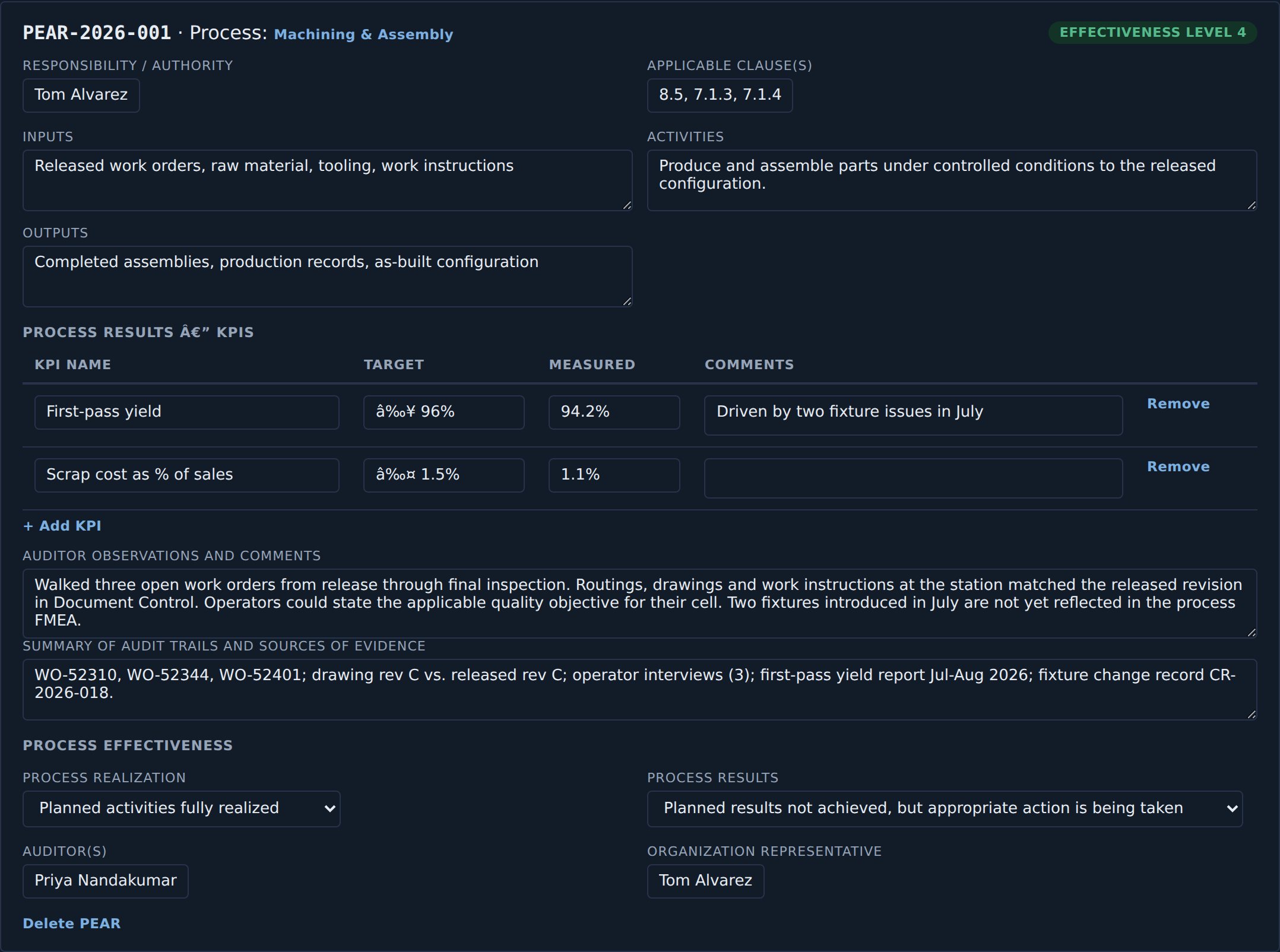
Inside an audit: a QMS Process Matrix (9101 Form 2) marking each clause Conforming, Nonconforming, Not Evaluated or Not Applicable per process, with an objective evidence summary per clause section. A PEAR (9101 Form 3) per process, whose inputs, activities, outputs and KPIs come straight from the process map. And an auditor's questionnaire generated per process from its documents, outputs and tagged clauses, with a standing clause 7.3 personnel-awareness check.
The 9.3.2 inputs assembled from what the system already knows — customer satisfaction, external provider performance, requirements register status, objectives status, risk and opportunity effectiveness — rather than retyped into a slide deck once a year.
Every clause of every standard you hold, status computed from the processes and documents actually tagged to it, filterable per standard.
Readiness per sector scope, open findings against their deadlines, calibration recall, overdue audits — all computed, none of it typed in.
Configuration items tied to the requirement they're built against, with every change logged and linkable to a real Change Management record. Then one release record per decision — product, serial, work order, evidence of conformity. Only people holding an active acceptance authority can be named as releaser, and AS9110C's flight-safety attestation and AS9120B's certifying statement appear only for the standards you actually hold.
Perception monitoring as the clause actually asks for it — surveys, direct feedback, meetings, compliments, warranty claims, dealer reports — with an improvement plan on any entry showing a real deficiency. This register feeds management review, rather than a count of complaints standing in for it.
What happens after something goes wrong, handled in the sequence and on the timeline a registrar expects.
10.2
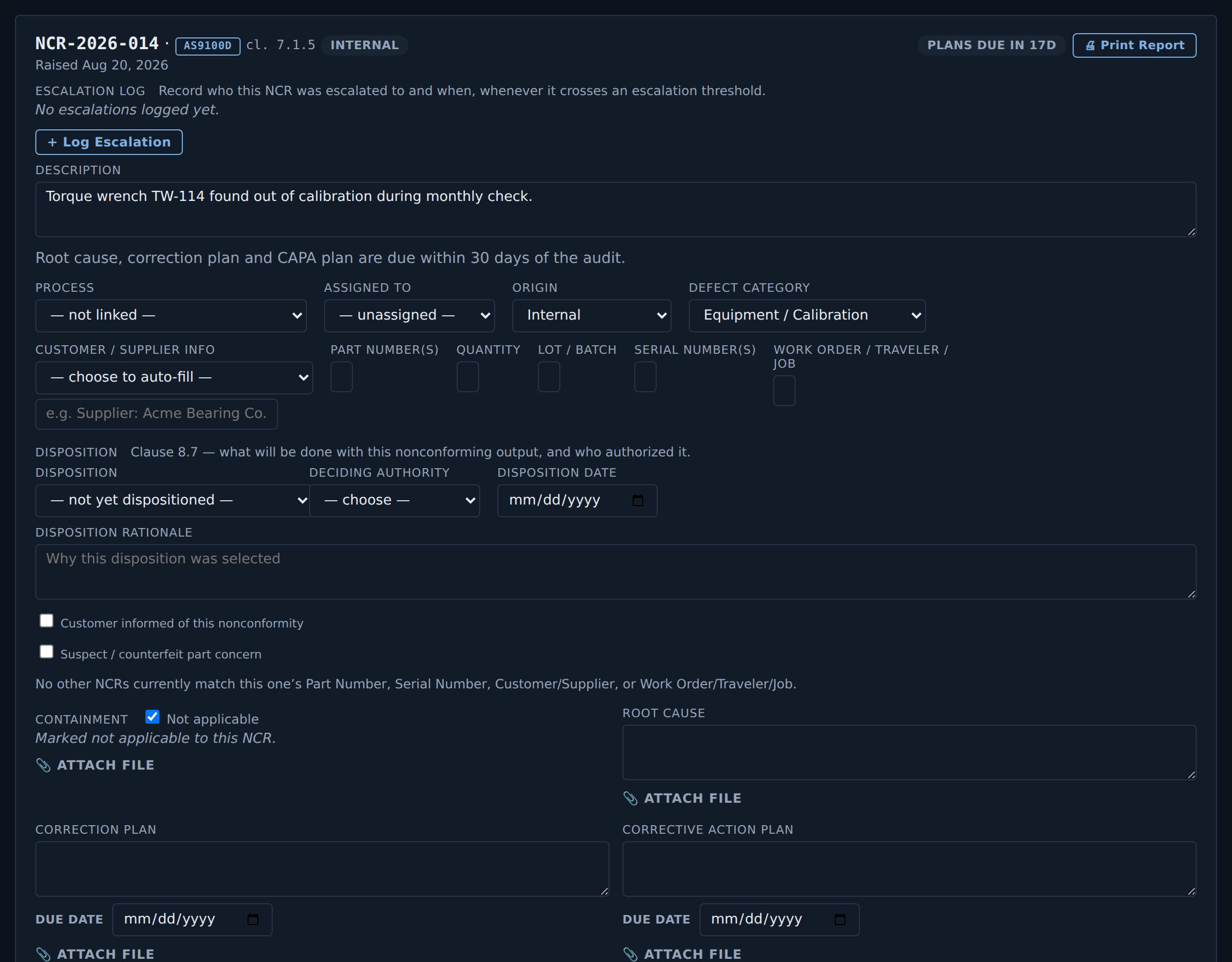
Containment, root cause, correction, corrective action and effectiveness verification, each with its own due date and objective evidence. The 30 and 60-day clocks run automatically, and an item that sits too long escalates on a policy you configure.
Root cause is worked with real tools rather than a free-text box: 5-Whys, fishbone across the standard six categories, fault tree analysis, Pareto and FMEA. Part number, lot, serial and work order are captured so recurrence across related nonconformances can be detected.
One master list of every action the system has generated — from risks, management review, audits and corrective actions — so nothing is only tracked inside the module that created it.
5-Whys, fishbone, fault tree, Pareto and FMEA, attached to the nonconformance they belong to rather than living in a separate spreadsheet.
Honest scope
JBird was built system-level first: context, planning, resources, documentation, audit, management review and improvement. The operational clauses are being closed now, highest audit risk first. We'd rather tell you where the line is than let you find out in a demo.
Clause 4 (context, interested parties, scope, processes), clause 5 (leadership, roles), clause 6 (risk, objectives, change), clause 7 (people, infrastructure, calibration, knowledge, competence, awareness, documented information), clause 9 (gap analysis, internal audit with the 9101 forms, customer satisfaction, management review) and clause 10.2 (nonconformity and corrective action).
From clause 8: external provider control (8.4), configuration management (8.1.2), acceptance authority media (8.5.2), preservation and shelf-life (8.5.4), release of product (8.6), and control of nonconforming output (8.7).
The rest of clause 8 — operational risk management (8.1.1), product safety (8.1.3), proactive counterfeit prevention (8.1.4, where the reactive half already works), customer communication and contract review (8.2), design and development (8.3), special process approval and first article inspection (8.5.1), customer property (8.5.3) and control of production changes (8.5.6).
Plus communication (7.4) and the remaining measurement and improvement work — monitoring-plan completeness (9.1.1), analysis and evaluation (9.1.3) and the continual improvement rollup (10.3).
Why that order
The system-level clauses are the ones every organization shares, whatever it makes. They're also where a paper QMS hurts most, because they cut across everything. The operational clauses are now being closed in order of how often they actually get sampled in an audit — release records, acceptance stamps and configuration control first, because those are the ones an auditor asks for on nearly every visit. The remainder are more specific to what you build, so they're being designed with pilot organizations rather than guessed at — which is part of what a pilot gets to shape.
Pilot program
Twenty-three modules are already built and working. Pilot organizations get the system at no cost during development, direct input on what gets built next, and a migration path when the IA9100 revision lands.