AS9120B · Stockist distributors
You don't cut metal. You buy parts, prove they're what they claim to be, keep the paperwork unbroken, and ship them on. That's a different quality system with a different centre of gravity — and AS9120B exists precisely because ISO 9001 and AS9100D don't describe it well.
Your process map, not a manufacturer's
JBird builds the interaction map from your own processes, so a distributor's map looks like a distributor. A useful rule when you draw yours: if nobody is primarily employed to execute an activity, it probably isn't a separate process. A machine shop with no purchasing manager folds purchasing into operations. Buying is your whole business, so it gets its own box, its own owner and its own metrics.
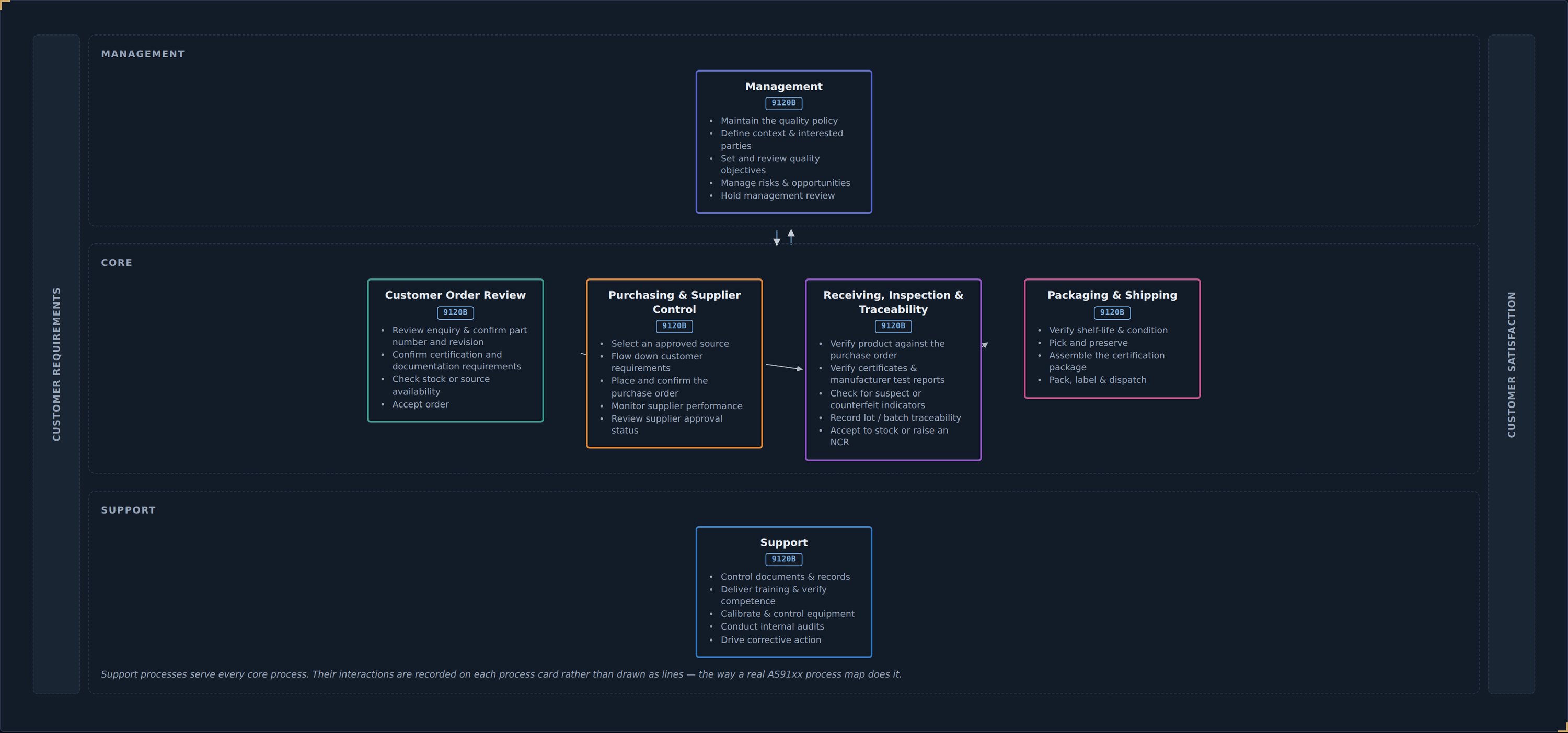
A distributor's interaction of processes, drawn from its own data. Click to enlarge.
Where AS9120B puts its weight
A distributor's audit spends its time in a narrow band: can you prove what this part is, where it came from, and that the paperwork travelled with it unbroken. JBird is built around that band.
Receiving records that carry the lot or batch through to what you shipped, so a customer's question about a part number four years old has an answer.
The two clauses AS9120B is arguably built around. Nonconformances raised at receiving carry root cause and effectiveness verification like any other finding.
An approved-source register with approval status and scope, plus on-time and quality performance measured per supplier rather than remembered.
Expiry, storage condition and quantity on hand, with expired and expiring-soon both surfaced on the dashboard rather than found during a stock check.
A review record per order — part number, revision, condition, certification required — and a change log with an acknowledgment step when it moves.
Evidence of conformity verified on receipt and passed down the chain, because in your business the certificate travelling with the part is the product.
Scope
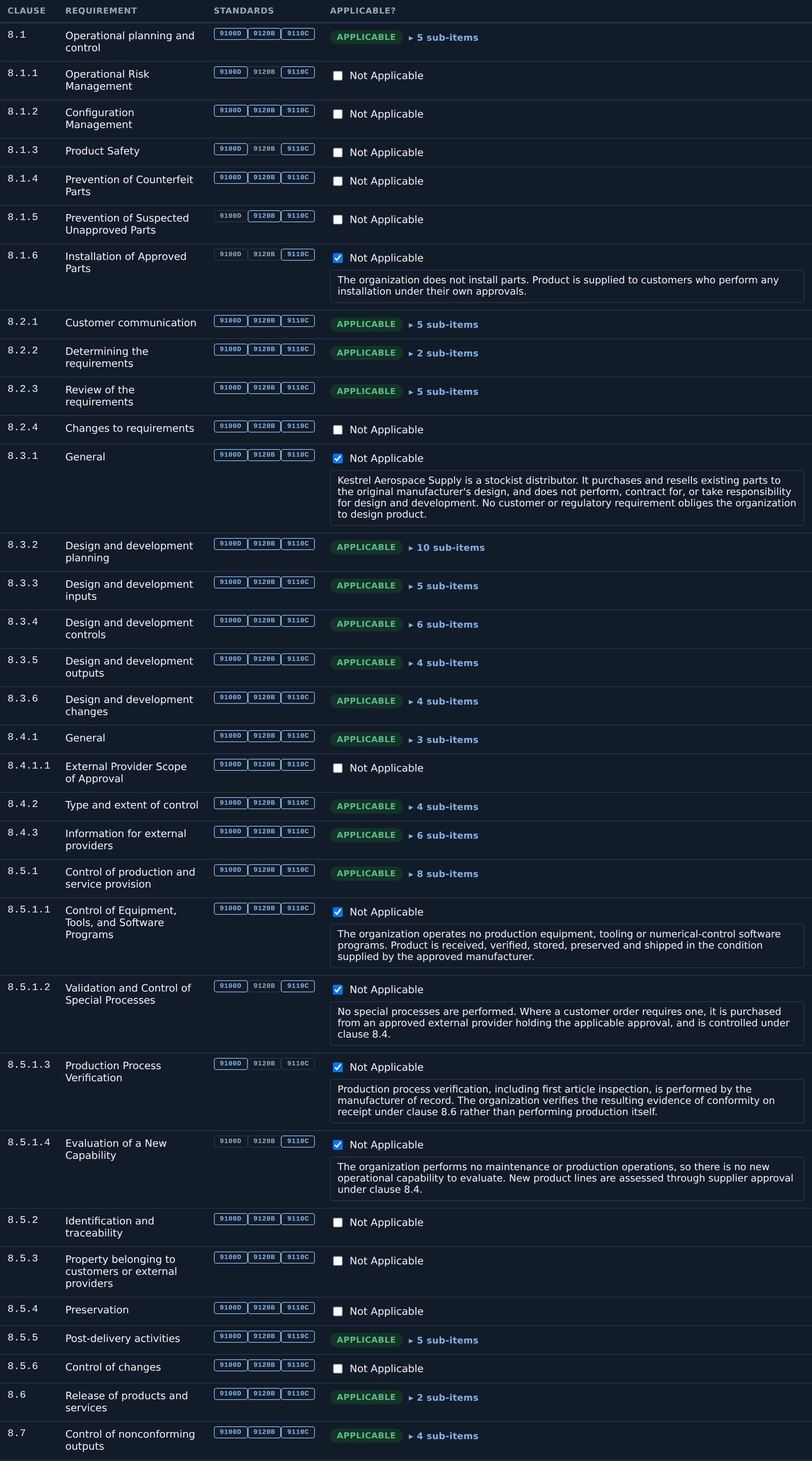
Clause 4.3 lets you exclude clause 8 requirements with a documented justification, and a distributor has real ones: you don't design, you don't run production, you don't install. JBird holds that assessment as a live record rather than a paragraph buried in a manual — and it writes it into your scope statement for you.
Every clause 8 requirement, its status, and the justification behind each exclusion. Click to enlarge.
Worth saying plainly
Design and development (8.3) is the largest single thing JBird has not built yet. For a stockist distributor it is also, usually, excluded from scope entirely — so the biggest gap in the product is one you would never have used. We would rather tell you that than let you find it in a demo.
What isn't excluded, and what you should ask us about: product safety (8.1.3) is built; customer or external-provider property (8.5.3) is still on the roadmap. The product page draws the line exactly →
Getting started
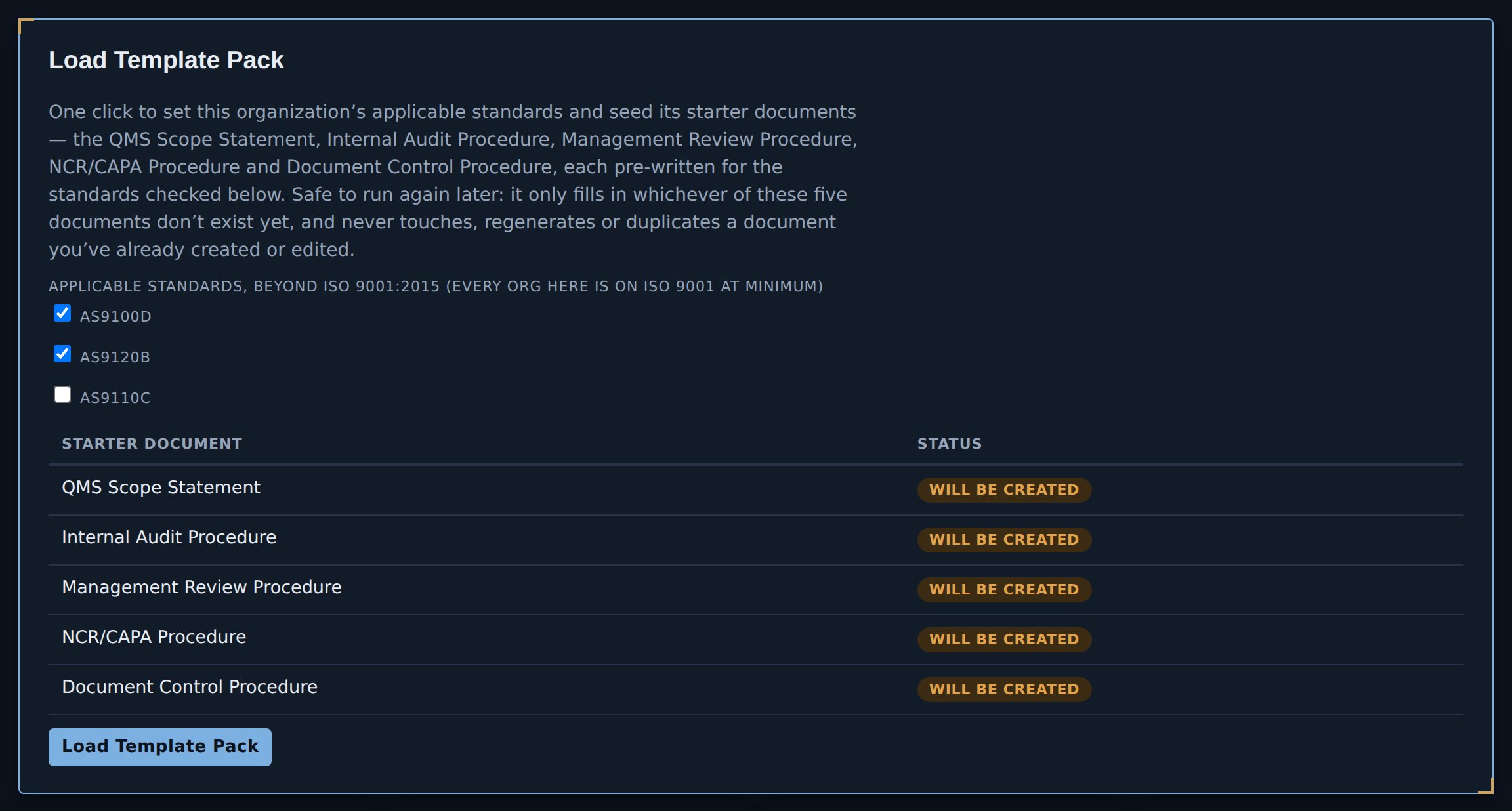
A template pack sets your standards scope and writes the five documents every quality system needs — scope statement, internal audit, management review, NCR/CAPA and document control — each scoped to AS9120B rather than a generic pack with the manufacturing clauses left in. Run it again later and it fills only what's still missing; it will never overwrite something you've edited.
Click to enlarge.
Pilot program
Twenty-seven modules are already built and working. Pilot organizations get the system at no cost during development, direct input on what gets built next, and a migration path when the IA9100 revision lands.